The Market as Civic Heart
Across Europe, the covered market — the halle, mercado, mercato, or hala — has long been more than a place to shop. It is civic infrastructure for appetite, and are vital centers where farmers meet urban cooks, fish arrives at dawn, and bakers sell out by noon. Architecture shelters exchange, but it also elevates it. Iron vaults, tiled domes, and glass canopies declare that food is not incidental to city life — it is central.
London & Barcelona
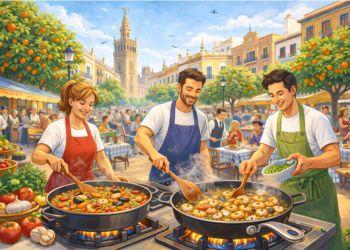
In London, Borough Market balances history with reinvention. Beneath Victorian ironwork, native-breed butchers stand beside global street-food vendors. A chef might source seasonal asparagus while a visitor eats grilled raclette, thai curries or seafood Paella. Borough’s uniqueness lies in this coexistence of provisioning and performance — it feeds locals, yet welcomes the world. This interplay is frequently seen in many Covered Markets throughout Europe.
In Barcelona, La Boqueria is more visceral. Seafood glistens whole on ice, jamón hangs overhead, fruit stalls blaze with colour. While tourists crowd the centre, local cooks quietly shop the edges. The market reveals Spain’s ingredient-first philosophy: raw materials displayed honestly, ready for tapas or paella. It is another vibrant example of how Covered Markets organize city life around food.
Southern Europe
Madrid’s Mercado de San Miguel demonstrates how a historic market can evolve into a gastronomic salon. Vermouth is poured beside oysters; croquetas are eaten standing. It is less about weekly shopping and more about edible theatre — a distilled expression of Spanish conviviality, fitting the ongoing transformation of Southern European covered Markets.
In Lisbon, Time Out Market Lisboa blends chef-led counters with traditional stalls. Bacalhau appears in multiple interpretations, pastéis de nata emerge warm, and the communal tables reinforce Portugal’s social dining culture, a hallmark of covered Markets in this region.
France and Italy maintain a stronger provisioning identity. Les Halles de Lyon Paul Bocuse celebrates charcuterie, cheeses, and pâtisserie as heritage. In Florence, Mercato Centrale keeps raw produce at its foundation — truffles, porcini, Tuscan salumi — with prepared dishes layered above. The architecture mirrors the cuisine: ingredient first, elaboration second, much like the tradition within European Covered Markets.
Central & Eastern Europe: Climate on Display
Budapest’s Great Market Hall rises monumentally near the Danube, filled with paprika braids, smoked sausages, pickles, and Tokaji wine. Climate shapes the stalls: preservation, fermentation, smoking, which characterizes the nature of these regional covered Markets.
In Vienna, Naschmarkt reflects imperial trade routes. Austrian sausages sit beside Ottoman and Balkan flavours, mapping migration through food. This is typical of the diverse offerings found in Central European covered Markets.
Poland’s markets remain deeply rooted in domestic cooking. Hala Mirowska in Warsaw sells twaróg, kiszonki, game meats, and poppy-seed pastries — a cuisine shaped by winters and woodland. In Kraków, the Sukiennice anchors the main square, with oscypek and forest honey revealing regional character. These locations are classic examples of these covered Markets maintaining local traditions.
Covered Markets: More Than Commerce
What unites these halles is visibility. They make geography edible. They educate tourists without museums and allow residents to maintain continuity with producers. In a digital age, covered Markets endure because they offer presence — conversation, tasting, negotiation.
Behind many of these elegant market displays lies a far larger, largely unseen infrastructure — none more significant than Rungis International Market outside Paris, the vast wholesale engine that feeds restaurants, retailers, and institutions across the capital.
A city can survive without its halles. But without them, it loses its edible centre — the place where land, labor, and appetite gather under one roof. Covered Markets provide this essential gathering point.