If Camembert is a lesson in timing, in catching the perfect, fleeting moment, then Comté is a lesson in something far harder to grasp. It is a lesson in duration.
This cheese does not rush. It cannot be hurried. It asks a cook—or anyone who takes a moment to taste it—to understand the most elusive ingredient of all: time itself.
Built by Landscape and Community
Comté carries the memory of its home, the Jura mountains in eastern France. It is a landscape of long, quiet winters and brief, brilliant summers. The grass grows for only a part of the year, and for generations, the people here faced a simple, urgent problem: how to capture the abundance of summer milk so it could sustain them through the cold, barren months.
Their answer was not solitude, but cooperation. They pooled their resources. Instead of each farm making its own small cheese, they brought their milk to a shared dairy, a fruitière, and together they created something massive. They made wheels of cheese so large—sometimes forty kilograms or more—that they could age slowly, safely, and gracefully for months, even years. The size wasn’t about spectacle; it was about survival. A big cheese is a patient cheese.
This spirit of community is still baked into every wheel. Comté is not the product of a single herd or a single farmer. It is a collective effort, a landscape distilled. The milk from the Montbéliarde cows, grazing on those high pastures, is taken to the fruitière, where it is gently cooked, pressed into its great moulds, and bathed in salt. Then, the real work begins.
The young wheels are carried down into cool, quiet cellars. And there, they wait.
What Time Really Does to Flavour
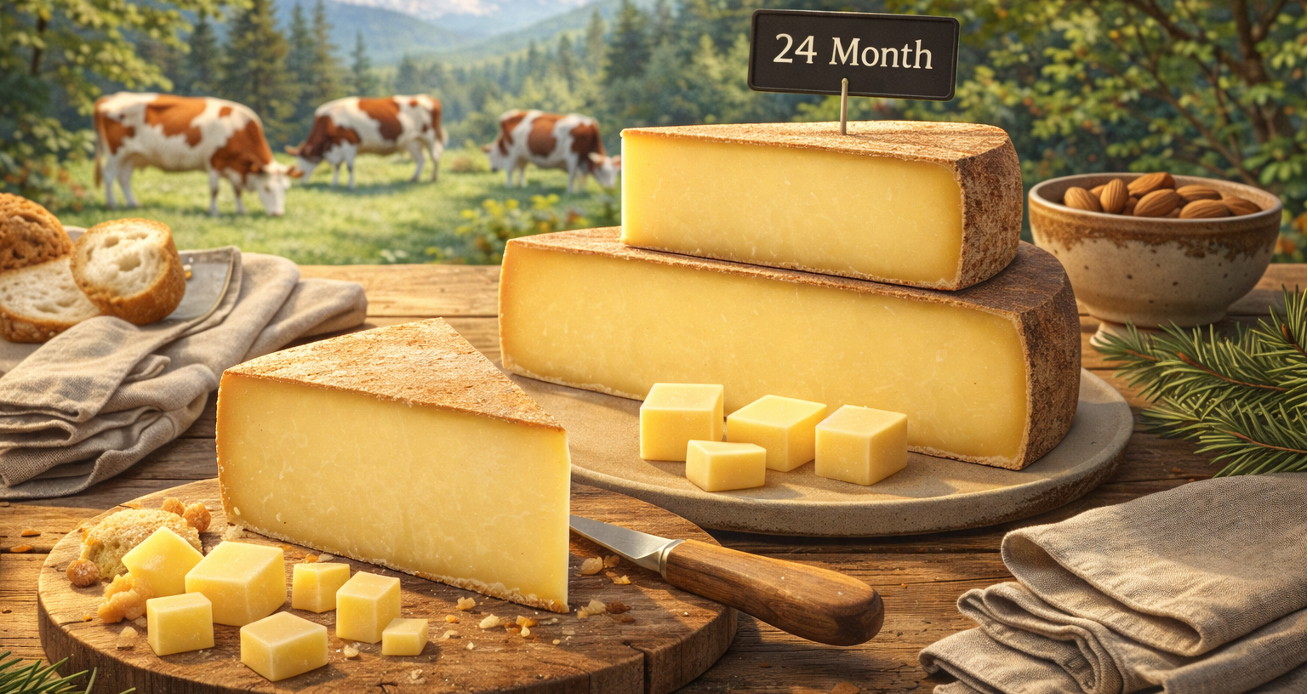
For 8 months, 12 months. For 18, or 24, or even longer. In the darkness, nothing dramatic happens in a single day. But over the course of seasons, everything changes. The wheels are brushed and turned by hand, a slow, rhythmic attention that feels almost like a meditation.
Listen to what time does:
- A young Comté is shy and milky, with a simple, nutty sweetness. It is the promise of what is to come.
- An older Comté grows confident. It develops savoury, roasted notes. It becomes almost meaty, with a depth that lingers on the tongue.
Inside the paste, a quiet alchemy is at work. Enzymes slowly, patiently break down proteins into amino acids, and fats into aromatic compounds. After many months, tiny white crystals appear, crunching faintly under your teeth. They aren’t salt, as many assume. They are clusters of concentrated flavour, little treasures forged by time.
This is the profound cooking lesson Comté offers: depth comes from gradual change, not intensity.
You see the same principle everywhere in a kitchen. A stock that simmers for hours doesn’t just taste stronger; it tastes more rounded. Caramel cooked slowly, with patience, becomes complex and bittersweet, not just burnt. A dough left to ferment overnight in the fridge becomes more digestible, more flavorful. The work happens when you aren’t looking.
Comté for the Cook
Comté is that same principle, made edible. It teaches that the foundation of a great dish can be laid long before the cook even steps into the kitchen. The flavour is already there, built by months of quiet transformation in a mountain cellar.
Because it melts so evenly, so willingly, without turning greasy or separating, Comté is a cook’s best friend in the kitchen. It slips into warm dishes—a bubbling gratin, a bowl of soup, a flaky pastry—and elevates them without shouting. It doesn’t add heaviness; it adds savouriness, a long, satisfying length to the flavour that hums in the background, supporting everything else.
To truly know Comté, though, you must let it warm to room temperature. A cold slice is a silent one, its aroma locked away. But as it warms, it begins to speak. It whispers of hazelnuts, of browned butter, and in the oldest wheels, there is even a hint of pineapple—a surprising, tropical brightness born from months of patient waiting.
Comté, then, is the embodiment of a simple truth: Good cooking starts long before the pan is hot.
Recipe 1: Comté Gougères (Cheese Puffs)
These little puffs are a perfect example of patience rewarded. They are airy, savoury, and utterly irresistible—a celebration of what Comté brings to warmth.
Ingredients
- 125 ml water
- 60 g butter
- 75 g plain flour
- 2 eggs
- 90 g Comté, finely grated
- ½ tsp salt
- A pinch of black pepper
Method
- Preheat your oven to 200°C and line a baking tray with paper.
- In a saucepan, bring the water, butter, and salt to a rolling boil. Tip in the flour all at once and stir with energy and purpose until a smooth dough forms and cleans the sides of the pan.
- Let it cool for just 3 minutes—this prevents the eggs from scrambling. Then, beat in the eggs one at a time. The dough will look like it’s breaking, but keep beating until it becomes glossy and comes together again.
- Fold in the grated Comté and a crack of black pepper.
- Using a spoon or a piping bag, drop small mounds onto the tray.
- Bake for 20–25 minutes, until they are puffed, golden, and smell like a warm mountain hut.
- Serve them warm. They will disappear in moments.
Recipe 2: Potato & Comté Gratin
This is the definition of simple, patient cooking. Slicing, layering, and then letting the oven do its slow, transformative work. The result is far more than the sum of its parts.
Ingredients
- 500 g potatoes, peeled and thinly sliced (a mandoline helps with patience here)
- 200 ml cream (or a mix of cream and milk for a lighter touch)
- 1 garlic clove
- 120 g Comté, grated
- Salt and freshly cracked black pepper
- A little butter, for the dish
Method
- Preheat your oven to 180°C. Rub a baking dish all over with the garlic clove, then smear it generously with butter.
- Layer the potato slices in the dish, seasoning each layer lightly with salt and pepper as you go.
- Pour the cream evenly over the potatoes. It will find its way down through the layers.
- Scatter the grated Comté over the top, covering the potatoes like a blanket.
- Bake for 50–60 minutes. You are looking for a knife to slide through the potatoes with no resistance, and the top to be bubbling and deep golden brown.
- This is the hardest part: let it rest for 10 minutes before serving. The structure needs this moment to set, to compose itself after its long, slow journey in the heat. It will be worth the wait.