Cassoulet is not simply a bean stew. It is architecture, and patience. And rural France codified into a clay pot.
Born in the Languedoc region — with Toulouse, Carcassonne and Castelnaudary each fiercely defending their version — cassoulet began as peasant sustenance. White beans stretched precious meat. Preservation techniques such as confit ensured flavour survived winter. What emerged over centuries was not refinement in the Parisian sense, but depth: slow cooking layered over slow cooking.
At its core, cassoulet is about collagen, starch, and time.
The beans — traditionally haricot or lingot — are soaked, then gently simmered until tender but intact. They must hold shape. Their starch will later thicken the broth naturally. The meats are not random additions; they are structural. Duck confit brings preserved richness and gelatin. Pork shoulder or belly provides body. Toulouse sausage contributes seasoning and fat. Often there is pork rind lining the pot — a subtle but important addition that enriches the cooking liquid as it melts.
The defining characteristic of cassoulet is repetition. It is baked slowly, uncovered, so a crust forms. That crust is broken and folded back into the stew multiple times. Each time, flavour concentrates. Each time, starch and gelatin bind the liquid further. The result is neither soup nor dry casserole — it is a cohesive, almost creamy mass where beans are distinct but suspended in rich, savoury depth.
Proper cassoulet should not be greasy. It should not be watery. It should not be aggressively herbed. Its power lies in restraint: thyme, bay, garlic, perhaps a hint of tomato, and good stock. Nothing more.
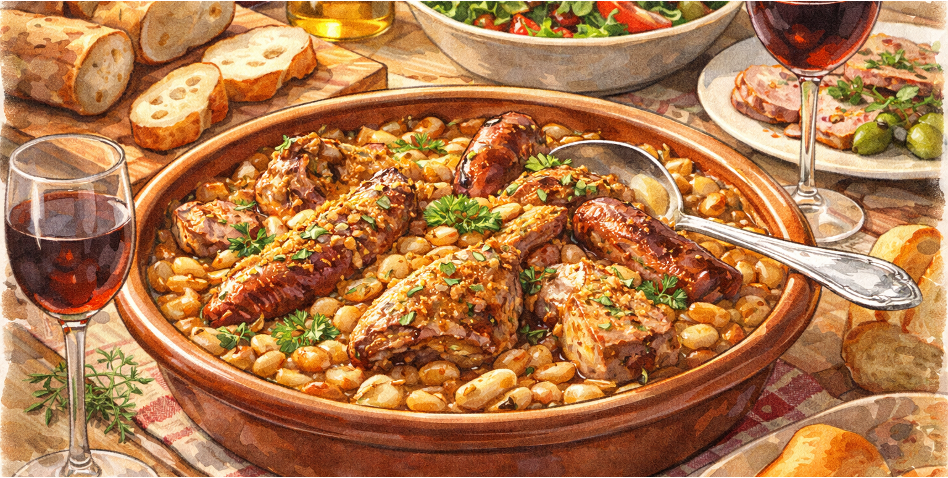
Cooked properly, the top forms a golden crust that cracks under the spoon, revealing tender beans and meats beneath. It is rustic, but not careless. Heavy, but not clumsy. It is a lesson in slow heat management and structural layering.
Cassoulet (Serves 6–8)
Ingredients
500 g dried haricot or cannellini beans
4 duck confit legs
400 g pork shoulder, large cubes
2 Toulouse sausages (or good quality pork sausages)
150 g pork belly or pancetta, diced
1 onion, diced
4 garlic cloves, crushed
2 bay leaves
2 sprigs thyme
1 tbsp tomato purée (optional, restrained)
1 litre good chicken or light pork stock
Salt and black pepper
100 g fresh breadcrumbs (optional for crust)
Method
1. Soak the Beans
Cover beans with cold water and soak overnight. Drain.
2. Cook the Beans
Place beans in a pot, cover with fresh water, bring to a gentle simmer. Cook 45–60 minutes until just tender but not collapsing. Drain, reserving some cooking liquid.
3. Build the Base
In a heavy pan, brown pork shoulder and pork belly in a little fat until lightly coloured. Remove. In the same pan, sauté onion and garlic gently until soft, not browned. Add tomato purée and cook briefly.
4. Combine
Add beans, browned pork, herbs, and enough stock to just cover. Simmer gently 30 minutes to allow flavours to integrate.
5. Assemble
Preheat oven to 160°C. In a deep casserole (traditionally earthenware), layer half the bean mixture. Nestle in duck confit legs and sausages. Cover with remaining beans and some cooking liquid. Liquid should just reach the top layer, not flood it.
6. Bake Slowly
Bake uncovered for 2–3 hours. A crust will form. Break it gently and push it back into the beans 2–3 times during cooking, adding a little reserved bean liquid if too dry.
Optional: sprinkle breadcrumbs in the final 30 minutes for enhanced crust.
The cassoulet is ready when the top is golden, the beans are creamy but intact, and the liquid is thick and cohesive — not soupy.
Rest 20 minutes before serving.