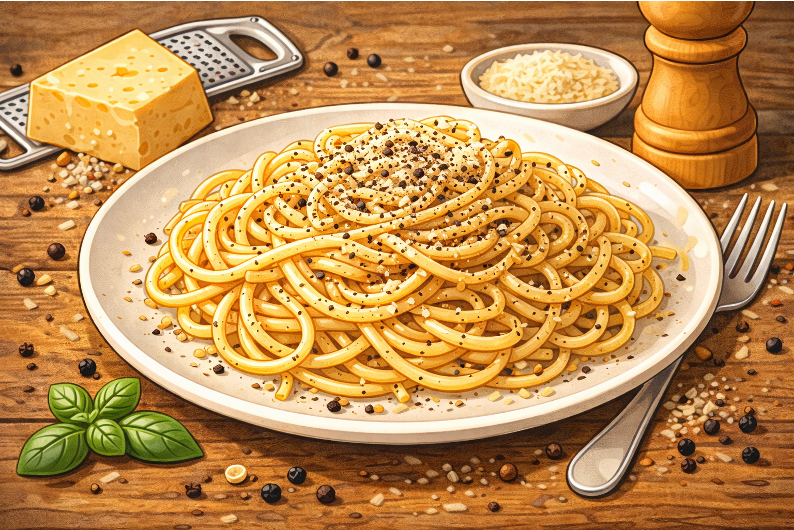
Cacio e pepe is often held up as the simplest of Roman pastas, yet it is also one of the most technically revealing dishes in Italian cooking. It contains almost nothing — just pasta, pecorino, pepper, and water — and for that very reason it exposes every decision the cook makes. There is nowhere to hide.
The dish originates in Lazio, particularly Rome, where sheep farming historically shaped the pantry. Pecorino Romano — salty, sharp, and crystalline — was easy to transport and long-lasting, making it ideal for shepherds moving across the countryside. Black pepper, once a luxury, became a staple in the Roman kitchen, prized for its warmth and depth rather than heat alone. Together, these two ingredients form the backbone of the dish: cacio (cheese) and pepe (pepper).
What makes cacio e pepe remarkable is not its ingredient list but its logic. At first glance it seems like a dry cheese pasta, yet when done properly it becomes glossy, creamy, and deeply savoury without a drop of cream or butter. The creaminess comes from a careful marriage of starch, fat, and heat — the same principles that underpin much of Italian cooking.
Pasta water is the invisible protagonist. As pasta cooks, it releases starch into the water, turning it into a silky liquid that can bind fat and cheese into a sauce rather than a clump. When this water meets finely grated pecorino, it creates an emulsion — a stable blend of liquid and fat — that coats each strand evenly.
Black pepper is not an afterthought. In Roman kitchens it is usually toasted briefly in a dry pan before the pasta is added, releasing its aroma and taming its raw bite. The pepper should perfume the dish rather than burn the back of your throat. Its role is to provide warmth and contrast to the saltiness of the cheese.
Shape matters here as much as technique. Long pastas like spaghetti, tonnarelli, or rigatoni work best because they hold the sauce smoothly and allow the cook to toss vigorously without breaking the strands. The act of tossing — or mantecatura — is essential. It is in that movement that sauce and pasta become one.
Cacio e pepe also embodies a broader Roman philosophy: richness through restraint. The dish is satisfying because it is intense, not because it is heavy. Every bite tastes concentrated, intentional, and alive with texture — al dente pasta against silky sauce, pepper against salt, warmth against starch.
For Cookdom, this dish is a perfect teaching tool. It forces learners to think about heat control, timing, emulsification, and seasoning rather than simply following steps. When you master cacio e pepe, you understand something fundamental about how Italian sauces work.
In that sense, cacio e pepe is not just a recipe; it is a way of thinking.
Classic Cacio e Pepe (serves 2)
Ingredients
- 200 g dried spaghetti, tonnarelli, or rigatoni
- 80 g finely grated Pecorino Romano
- 1½ tsp freshly cracked black pepper
- Fine salt for the pasta water
Method
- Bring a large pot of water to a rolling boil and salt it well — it should taste like the sea. Add the pasta and cook until just shy of al dente.
- Toast the cracked pepper gently in a cold, dry pan for 30–40 seconds until fragrant (do not burn). Add about 120 ml of hot pasta water to the pan and keep it warm on low heat.
- In a bowl, mix the grated pecorino with 2–3 tablespoons of hot pasta water to form a thick, smooth paste. This prevents the cheese from clumping later.
- When the pasta is nearly done, transfer it directly into the peppery water (do not drain). Toss for 30 seconds so the pasta absorbs flavour.
- Remove the pan from the heat. Add the pecorino paste and toss vigorously, adding more pasta water a tablespoon at a time until the sauce becomes glossy and creamy, clinging to each strand.
- Taste and adjust — you should not need more salt, as pecorino is already salty.
- Serve immediately with extra cracked pepper and a little more grated pecorino on top.
Texture test: the sauce should be silky, not watery, and never grainy.