In Spanish cooking, rice behaves differently than in many other culinary traditions. Rather than being stirred, drained, or turned creamy, rice often cooks by absorption, taking in flavorful liquid until each grain reaches balance. At the center of this approach stands bomba rice, a variety prized not for speed or softness, but for control.
Understanding bomba rice and absorption cooking explains why Spanish rice dishes feel structured, confident, and deeply seasoned without becoming heavy.
What Makes Bomba Rice Unique
Bomba rice grows primarily in eastern Spain, especially in Valencia and the Ebro Delta. Unlike many short-grain rices, bomba rice expands outward rather than splitting or bursting. Each grain absorbs liquid evenly while retaining its shape.
This behavior allows bomba rice to take in more broth than other varieties—often up to three times its volume—without turning mushy. As a result, flavor penetrates the grain instead of coating the surface.
The first time I cooked bomba rice, I expected creaminess. Instead, I found clarity. Each grain stood on its own, fully flavored and intact.
Absorption Cooking vs. Stirring
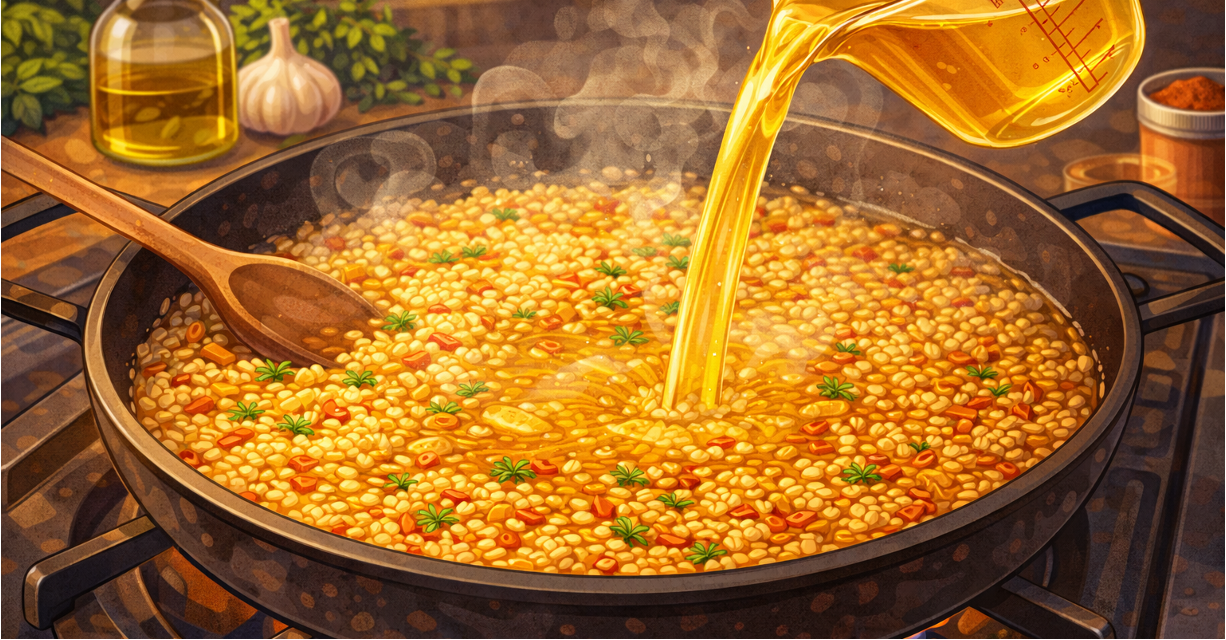
Absorption cooking depends on restraint. Once liquid meets rice, stirring largely stops. The rice absorbs broth gradually while heat evaporates excess moisture.
This method contrasts sharply with risotto, where constant movement releases starch. Bomba rice does the opposite. It keeps starch contained, preserving separation.
Walking away from the pan felt uncomfortable at first. However, trusting absorption cooking taught me patience. Interference only disrupted balance.
Why Bomba Rice Excels at Absorption
Bomba rice has a high amylose content, which helps grains remain firm. Instead of releasing starch into the liquid, the rice holds it inside.
This structure allows bomba rice to soak up flavor while maintaining texture. Broth becomes part of the grain rather than something clinging to it.
That internal seasoning defines Spanish rice dishes.
The Role of the Pan and Heat
Absorption cooking with bomba rice requires a wide, shallow pan. Spreading rice in a thin layer ensures even cooking and evaporation.
Heat starts strong to bring liquid to a boil. Then it reduces gradually, allowing rice to absorb without agitation. Toward the end, heat increases slightly to form socarrat if desired.
Managing heat matters more than timing.
Flavor Must Be Built Before Rice
Because absorption cooking leaves little room for adjustment later, flavor must be right before rice enters the pan.
Sofrito, stock, salt, and aromatics must already feel balanced. Once rice absorbs liquid, correction becomes difficult.
I learned this through trial. Underseasoned broth led to bland rice, no matter what followed.
Why Bomba Rice Forgives Mistakes
Despite its precision, bomba rice remains forgiving. It absorbs more liquid without collapsing, giving cooks a margin for error.
This tolerance makes bomba rice ideal for communal cooking, outdoor fires, and variable heat sources.
Spanish cooks trust it because it responds predictably.
Bomba Rice and Time
Absorption cooking respects time. Rushing leads to uneven cooking. Waiting allows grains to finish gently.
Rice needs rest after cooking. This pause redistributes moisture and stabilizes texture.
Skipping rest leaves rice unsettled.
What Bomba Rice Teaches
Bomba rice teaches restraint. It rewards preparation over correction. It values patience over motion.
Once I stopped trying to control it, rice became easier, not harder.
Bomba rice does not ask for attention. It asks for trust.
Why Bomba Rice Defines Spanish Rice Cooking
Spanish rice dishes rely on clarity rather than creaminess. Bomba rice makes that possible.
Each grain absorbs flavor without losing identity. The dish feels complete rather than crowded.
Understanding bomba rice and absorption cooking reveals why Spanish rice tastes confident instead of fussy.
In Spanish kitchens, rice does not need constant attention. It needs the right conditions—and then the space to become itself.