A Culinary Map
Spanish cooking is often summarised in one word: fiesta. But that word flattens something far richer. What looks celebratory, generous, and relaxed on the table is the result of centuries of history. Geography shaped it. Scarcity shaped it. Trade, conquest, and migration shaped it too. Above all, it grew from a fiercely local relationship to ingredients.
If Italian cooking is about clarity, Spanish cooking is about place. Every plate carries its landscape within it. The olive groves of Andalucía. The wheat fields of Castilla. The Atlantic cliffs of Galicia. The rice lagoons of Valencia. The sheep pastures of La Mancha. You can taste this in pan con tomate. In paella valenciana. In pulpo a la gallega, and in slow-cooked lamb (cordero asado), where land and fire speak together.
Across regions, Spain tells different stories. Valencia has rice traditions like arroz al horno (baked rice of Valencia), arroz negro, fideuà, and arroz caldoso. In Catalonia, fire-roasted escalivada catalana, the calçots and the romesco ritual, and suquet de peix connect vegetables, seafood, and smoke. The Basque Country has marmitako (Basque tuna stew) and a thriving pintxos culture which reveal a maritime identity shaped by tide and storm.
History is always present: the Moorish influence on Spanish cuisine lingers in almonds, citrus, and irrigation, while New World ingredients in Spain — tomatoes, peppers, and potatoes — transformed everything from stews to sauces.
Ingredients as Culture, Not Just Food
At the centre of Spanish cooking lies oil. Spanish olive oil culture is not a technical detail — it is the flavour of the country itself. Oil carries the smoke of pimentón de la Vera, the perfume of Spanish saffron, and the acidity of sherry vinegar in Spanish cooking.
Rice is sacred. To understand Spain you must understand bomba rice and absorption cooking, why rice should not be stirred, and why the prized rice socarrat — the caramelised crust at the bottom of the pan — is considered a triumph rather than a mistake.
Cured foods define Spanish identity. Jamón ibérico culture is built on acorns, pasture, and time, while Spanish cured chorizo and morcilla and blood sausage traditions show how paprika, fat, and patience become memory. Cheese matters too: queso manchego sits at the centre, but Spain stretches far beyond it — Spanish cheese beyond Manchego includes Idiazábal, Tetilla, and Mahón.
Bread is equally fundamental. Spanish bread culture, from pan de pueblo to airy pan de cristal & modern Spanish bread, shapes how Spaniards eat sauces, stews, and tomatoes. Even nuts carry meaning — Spanish almonds & Marcona nuts in cooking appear in romesco, ajo blanco, and festive sweets.
How Spaniards Eat Together
Food in Spain is social before it is technical. Tapas as a social system is less about portion size and more about movement — plates travel, people talk, tables expand, and strangers become friends.
Classic bar foods like gambas al ajillo, boquerones en vinagre, patatas bravas, and alioli (garlic emulsion) create a shared language of garlic, oil, vinegar, and heat. Tiny montaditos and open sandwiches distil big flavours into a single bite.
In the Canary Islands, this sociability takes a volcanic twist with mojo verde vs mojo rojo poured over Canarian wrinkled potatoes (papas arrugadas) — salty, tender, and communal.
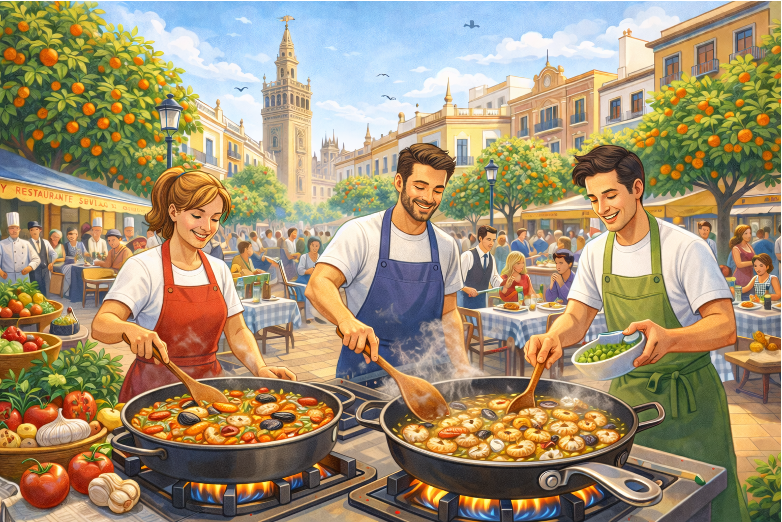
At home and in restaurants alike, Spaniards gather around the same dish: shared pans and communal eating is a philosophy, not a convenience. Whether it is a paella, a cazuela of beans, or a pan of grilled fish, eating together is central to Spanish life.
Land, Sea, and Fire
Spain lives between field and ocean. Nowhere is this clearer than in Galician seafood traditions, where barnacles, mussels, octopus, and hake define a coast shaped by the Atlantic. Preservation plays a role too — the seafood conservas tradition treats tinned sardines and tuna as delicacies, not compromises.
Along the Mediterranean, fishermen’s kitchens produced suquet de peix, arroz negro, and fideuà, while the Cantabrian coast gave the world Anchovies of the Cantabrian coast — fresh vs cured.
Fire is equally important. Fire, smoke, and grilling in Spain shape everything from vegetables to lamb. In spring, Catalans celebrate with calçots and the romesco ritual, while in Castilla, wood ovens deliver crackling slow-cooked lamb (cordero asado).
Herbs play a quiet but vital role — Mediterranean herb use in Spain (bay, rosemary, thyme) perfumes stews without overpowering them.
Technique: Slow Cooking, Frying, and Preservation
Spanish technique is often hidden inside tradition. In Madrid, cocido madrileño unfolds in stages — soup, vegetables, then meat — a meal that teaches patience. In Asturias, fabada asturiana shows how beans, fat, and smoke can become silk.
Coastal technique shines in bacalao al pil-pil, where olive oil and fish gelatin are coaxed into an emulsion — a masterclass in gentle heat. Meanwhile, sofrito: Spain’s hidden backbone threads through countless stews and rice dishes.
Andalucía offers another kind of mastery: Andalusian frying culture creates ethereal pescaíto frito, where batter, oil temperature, and timing matter more than any spice.
Preservation is everywhere. The escabeche technique marries vinegar, oil, and aromatics, while confit in olive oil shows how gentle cooking can extend shelf life and deepen flavour. Acidity — especially sherry vinegar in Spanish cooking — is the invisible spine of balance.
Rice has many faces. Dry paella sits beside arroz caldoso, and behind both lies understanding of saffron and rice chemistry and the role of stock and fumet in Spanish cooking.
Markets, Seasons, and Everyday Life
To understand Spanish cooking you must understand how Spaniards shop. Spanish market culture (mercados) is tactile, conversational, and seasonal — cooks buy what is alive, fragrant, and local.
The fertile huerta vegetables of Valencia feed paellas, pisto, and salads, while Spanish salad culture (ensaladilla rusa & more) reveals how even “cold dishes” carry technique and tradition.
Wine flows through daily cooking. The briny sparkle of txakoli wine of the Basque coast contrasts with the depth of Rioja and food pairing, where wine becomes a culinary partner rather than decoration.
Regional peppers add character — regional chilies and peppers of Spain like ñora, padrón, and guindilla define heat, aroma, and colour. Snails appear too: caracoles (snails) in Spanish cuisine bridge rural kitchens and urban tapas bars.
Everyday life balances celebration and routine. Feasting vs everyday cooking in Spain — restaurants, homes, bars explains how the same culture embraces both humble stews and grand banquets. One-pot dishes like puchero and one-pot cooking link kitchens from Andalucía to Galicia.
Summer brings gazpacho andaluz and its thicker cousin salmorejo cordobés; winter brings beans, lamb, and embers. Dessert follows the calendar — horchata de chufa in heat, turrón and festive sweets at Christmas.
And above all, Spanish cooking is guided by seasonality in Spanish kitchens — a rhythm of harvests, tides, and markets that decides what belongs on the table.
To cook Spanish food is to enter this rhythm of land, sea, fire, and fellowship — and to understand that every dish is a story of where it comes from.