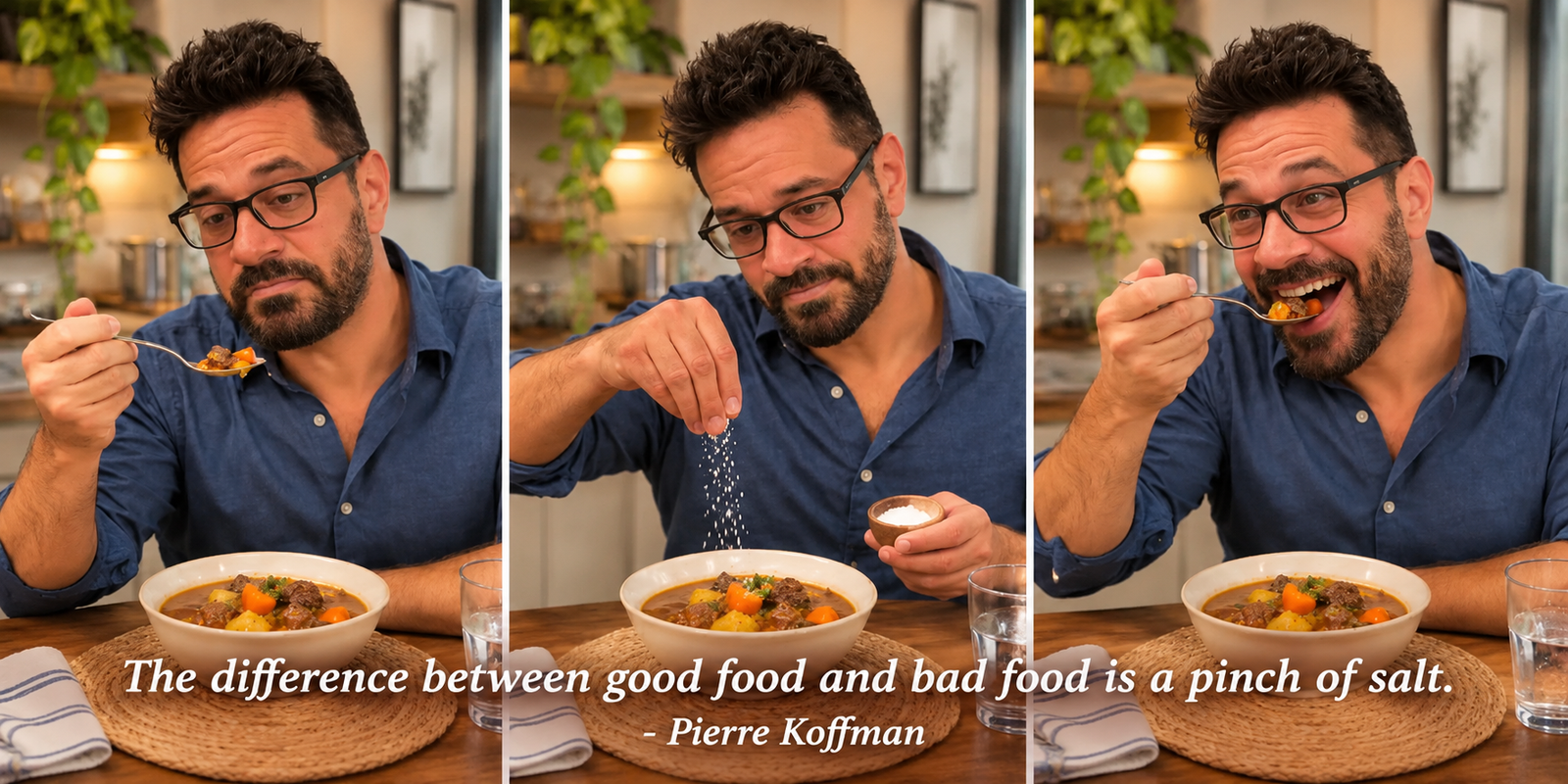
The difference between a bland meal and a delicious one can be as small as a pinch of salt. But knowing when to add it, how much to use, and what else your food needs is where good cooking begins.
You’ve spent an hour making a vegetable curry. The onions are golden, the spices smell wonderful, and the gravy has reached the perfect consistency. Yet when you taste it, something feels missing. You add another spoonful of garam masala, but the flavour barely improves.
The problem might be much simpler. Perhaps the dish needs a little salt, a squeeze of lemon, or a few minutes for its flavours to come together.
Learning how to season food properly is one of the most useful cooking skills you can develop. It helps you recognise what a dish needs, adjust ingredients with confidence, and avoid the common mistake of adding more spices whenever something tastes bland.
Good seasoning isn’t about using complicated ingredients. It’s about understanding salt, acidity, sweetness, bitterness, and savoury depth, then using them at the right moments.
What Does Seasoning Food Actually Mean?
Seasoning is the process of adjusting a dish’s taste to make its ingredients more enjoyable and balanced. Salt is the most familiar seasoning, but it isn’t the only ingredient that matters.
Acidic ingredients such as lemon juice and vinegar add sourness and contrast. Sugar or jaggery can soften excessive sharpness. Ingredients such as mushrooms, tomatoes, and fermented sauces contribute umami, the savoury fifth taste.
Herbs and spices also shape a dish’s flavour, although they primarily contribute aromas and other sensations rather than simply increasing its basic tastes.
This distinction matters because adding more chilli powder to an underseasoned curry won’t necessarily solve the problem. The curry may become hotter while remaining just as flat.
The first step towards better seasoning is learning to identify what is actually missing.
Why Salt Makes Food Taste Better
Salt does more than make food salty. At appropriate concentrations, it changes how we perceive other tastes, helping certain flavours become more noticeable and reducing the perception of some bitter compounds.
Imagine tasting a spoonful of unsalted vegetable soup. You might recognise the vegetables, but their flavours may seem muted. Add a small amount of salt, stir, and taste again. The carrots may seem sweeter, the onions more noticeable, and the broth more satisfying.
Salt also affects food during cooking. It can influence moisture movement, protein behaviour, and texture, depending on when and how it is used.
However, more salt doesn’t always mean better flavour. Once a dish is adequately seasoned, additional salt can overwhelm the ingredients.
The goal is to use enough salt to support the food without making saltiness the dominant sensation.
When Should You Add Salt During Cooking?
One of the most useful habits is seasoning at appropriate stages rather than waiting until the dish is completely finished.
For example, when preparing a vegetable stew, lightly seasoning the vegetables as they cook can help develop a balanced result. Later, after adding stock or tomatoes, you can taste the liquid and adjust the seasoning again.
This approach allows you to monitor how the dish changes as ingredients release moisture and flavours develop.
However, there are important exceptions. If you’re preparing a sauce that will reduce significantly, adding too much salt early can create problems because evaporation concentrates the dissolved salt.
Similarly, ingredients such as soy sauce, salted butter, cheese, and commercial stock may already contribute substantial amounts of sodium.
A useful principle is to season gradually, but reserve the final adjustment until the dish has reached its intended consistency.
How Much Salt Should You Use?
There is no single amount of salt that works for every recipe. The correct quantity depends on the ingredients, cooking method, portion size, and intended flavour.
A vegetable soup, a grilled piece of meat, and a fresh salad all require different approaches.
Salt crystals also vary in size and density. A teaspoon of fine table salt may contain considerably more salt by weight than a teaspoon of coarse flaky salt.
For consistency, measure salt by weight when following recipes that specify grams. When cooking without a recipe, begin with a small quantity and increase gradually.
Taste after each addition, allowing enough time for the salt to dissolve and distribute evenly.
If you’re cooking for someone who needs to limit sodium intake, consider using herbs, aromatics, and suitable acidic ingredients to create flavour while following their dietary guidance.
How to Season Meat Properly
Meat benefits from seasoning that reaches beyond the surface whenever possible, although the best method depends on the cut and cooking technique.
For many whole cuts of meat, salting in advance allows salt to dissolve in surface moisture and gradually diffuse into the meat. This can improve seasoning and influence moisture retention during cooking.
A technique called dry brining involves applying salt directly to the meat and allowing it to rest under refrigeration before cooking.
For example, a steak can be salted in advance and refrigerated on a rack or suitable tray. The exact resting time depends on its thickness and the desired result.
Before searing, remove excess surface moisture to encourage browning. Pepper and other spices can be added according to the cooking method, although some ground spices may burn under intense heat.
Always follow safe handling and cooking practices. Seasoning improves flavour but doesn’t replace proper refrigeration or cooking to safe temperatures.
How to Season Vegetables
Vegetables respond differently to seasoning depending on their water content, texture, and cooking method.
When roasting vegetables, tossing them with a modest amount of oil and salt helps distribute the seasoning across their surfaces. Browning during roasting adds further flavour through chemical reactions, including the Maillard reaction.
For sautéed vegetables, salt can be added during cooking, but timing matters. Salting moisture-rich vegetables such as mushrooms encourages water release, which may be useful for some preparations but can delay browning if the pan becomes crowded.
For boiled vegetables, lightly salted cooking water can improve seasoning, although the amount absorbed varies between ingredients.
A final squeeze of lemon juice, a little vinegar, or fresh herbs can also improve vegetables that taste rich or dull.
How to Season Soups, Stews, and Curries
Liquid dishes require particular care because their flavour changes as they simmer.
A soup may begin with a mild flavour, become more concentrated as water evaporates, and develop additional savoury notes as the ingredients cook.
Start by building a flavourful base with onions, garlic, ginger, or other aromatics. Cook these ingredients according to the recipe before adding liquids.
Season the dish moderately during cooking, especially if the liquid will reduce. Taste again once the ingredients are tender and the final consistency has been reached.
If the dish tastes bland, consider whether it needs salt, acidity, or additional savoury depth.
For a dal, for example, salt may bring out the flavour of the lentils, while a squeeze of lemon can add brightness. A final tempering of spices in oil or ghee contributes aroma and richness.
These adjustments serve different purposes, which is why adding more salt isn’t always the right answer.
The Difference Between Seasoning and Adding Spices
Seasoning and spicing are closely related, but they aren’t identical.
Salt changes the perception of taste, while spices contribute distinctive aromatic compounds and, in some cases, heat, bitterness, or other sensations.
Cumin, coriander, cardamom, cinnamon, and black pepper each bring different flavour characteristics. Chilli contributes aroma and pungency, with capsaicin producing a burning sensation rather than a basic taste.
A curry containing plenty of spices can still taste underseasoned if it lacks enough salt or appropriate acidity.
Likewise, a well-seasoned dish can be delicious with very few spices.
Understanding the difference helps prevent overcomplicated cooking. Before adding another spoonful of spice, taste the dish and decide whether its existing flavours simply need better balance.
How Acid Helps You Season Food
Acidity is one of the most useful tools for improving a dish that tastes heavy or flat.
Lemon juice, lime juice, vinegar, tamarind, yoghurt, and amchur all contribute sourness, although their aromas and textures differ.
A small amount of lemon juice can make a rich soup feel fresher. Vinegar can add contrast to a slow-cooked stew, while tamarind contributes characteristic tartness to certain Indian dishes.
Acid doesn’t replace salt, but it can provide the missing contrast in food that already contains sufficient seasoning.
When adding acid, begin with a small amount. Stir, taste, and repeat only if necessary.
Too much acidity can overwhelm the other flavours, especially in delicate soups or sauces.
How to Recognise What Your Dish Is Missing
Learning to season well becomes easier when you can identify the problem before reaching for an ingredient.
| What you notice | Possible cause | What to try |
|---|---|---|
| Food tastes flat or muted | Insufficient salt | Add a small pinch and taste |
| Dish tastes rich and heavy | Lacks acidity | Try a little lemon or vinegar |
| Sauce tastes too sharp | Excessive acidity | Add a little sweetness or dilute |
| Food tastes overly sweet | Too much sweetness | Try suitable acidity or dilution |
| Dish lacks savoury depth | Insufficient umami | Add mushrooms, tomato paste, or stock |
| Food tastes harshly bitter | Burnt or naturally bitter ingredients | Remove burnt elements or rebalance |
| Dish tastes too salty | Excessive salt concentration | Add unsalted ingredients or dilute |
These adjustments are starting points rather than guaranteed solutions. A dish may have more than one problem, and the best correction depends on its ingredients.
Why You Should Taste Food Throughout Cooking
Tasting is one of the most important habits in professional and home kitchens.
Ingredients change as they cook. Onions become sweeter, liquids reduce, spices release aromas, and acidic ingredients may become more concentrated or change in character.
A dish that tastes balanced halfway through cooking may require a different adjustment before serving.
Use a clean tasting spoon and allow hot food to cool enough to taste safely. Pay attention to the dominant flavour, then ask whether anything seems missing or excessive.
Taste again after making adjustments rather than adding several ingredients at once.
This simple practice develops your ability to recognise seasoning problems before they become difficult to correct.
Why Food Tastes Different at Different Temperatures
Temperature influences how we experience flavour and aroma.
A very hot soup may seem different from the same soup after it cools slightly. Cold foods can also seem less aromatic because fewer volatile compounds reach the nose.
This is especially important when preparing foods intended to be served chilled, such as salads, cold soups, and certain desserts.
For reliable seasoning, taste food at a temperature reasonably close to how it will be served.
A dressing that tastes balanced at room temperature may need another check after being mixed with cold vegetables.
How to Fix Food That Is Too Salty
Oversalting can be difficult to correct because salt dissolves throughout a dish.
The most reliable approach is usually dilution. Adding unsalted water, stock, vegetables, or other suitable ingredients can reduce the salt concentration.
For example, an overly salty soup may improve after adding more unsalted liquid and vegetables. A thick sauce may require additional unsalted base ingredients.
Adding sugar or lemon juice can change the overall taste, but neither removes sodium.
The popular suggestion to add a potato to absorb excess salt is unreliable. Potatoes absorb seasoned liquid, but they don’t selectively remove enough salt to correct most oversalted dishes.
Prevention remains easier than correction, particularly when cooking recipes that require reduction.
Common Seasoning Mistakes to Avoid
One common mistake is adding all the salt at the beginning without considering how much the dish will reduce.
Another is using spices to compensate for missing salt or acidity. This can create an overly complicated flavour without solving the original problem.
Cooks also sometimes forget that ingredients such as cheese, pickles, soy sauce, and stock cubes already contain salt.
Failing to taste before serving is another frequent problem. Even a familiar recipe can produce different results depending on the ingredients and cooking conditions.
Finally, avoid making several large adjustments at once. If you add salt, sugar, vinegar, and chilli together, it becomes difficult to understand which change improved or damaged the flavour.
A Simple Exercise to Improve Your Seasoning Skills
A useful way to practise seasoning is to prepare a small quantity of unsalted vegetable soup or cooked lentils.
Divide the food into four portions. Leave the first unchanged, add a small pinch of salt to the second, a few drops of lemon juice to the third, and both salt and lemon juice to the fourth.
Taste each portion carefully and compare the results.
You may notice that salt makes the ingredients more noticeable, while lemon introduces sharpness and freshness. The portion containing both may taste more balanced, depending on the original dish.
Repeat the experiment with different foods to understand how seasoning interacts with sweetness, richness, and savoury depth.
The Secret to Proper Seasoning Is Paying Attention
Learning how to season food properly isn’t about memorising an exact number of pinches or teaspoons. It’s about understanding what different ingredients contribute and recognising when a dish needs an adjustment.
Salt brings out flavour, acidity creates contrast, sweetness can soften sharpness, and umami contributes savoury depth. Herbs and spices add further complexity through their aromas and distinctive characteristics.
The most important habit is simple: taste, adjust, and taste again.
Begin with modest seasoning, account for ingredients that already contain salt, and make final adjustments once the dish has reached its intended consistency.
With practice, you’ll become better at recognising whether your food needs another pinch of salt, a little lemon juice, or simply more time to cook.
And that’s when seasoning becomes less about following a recipe and more about understanding the food in front of you.