
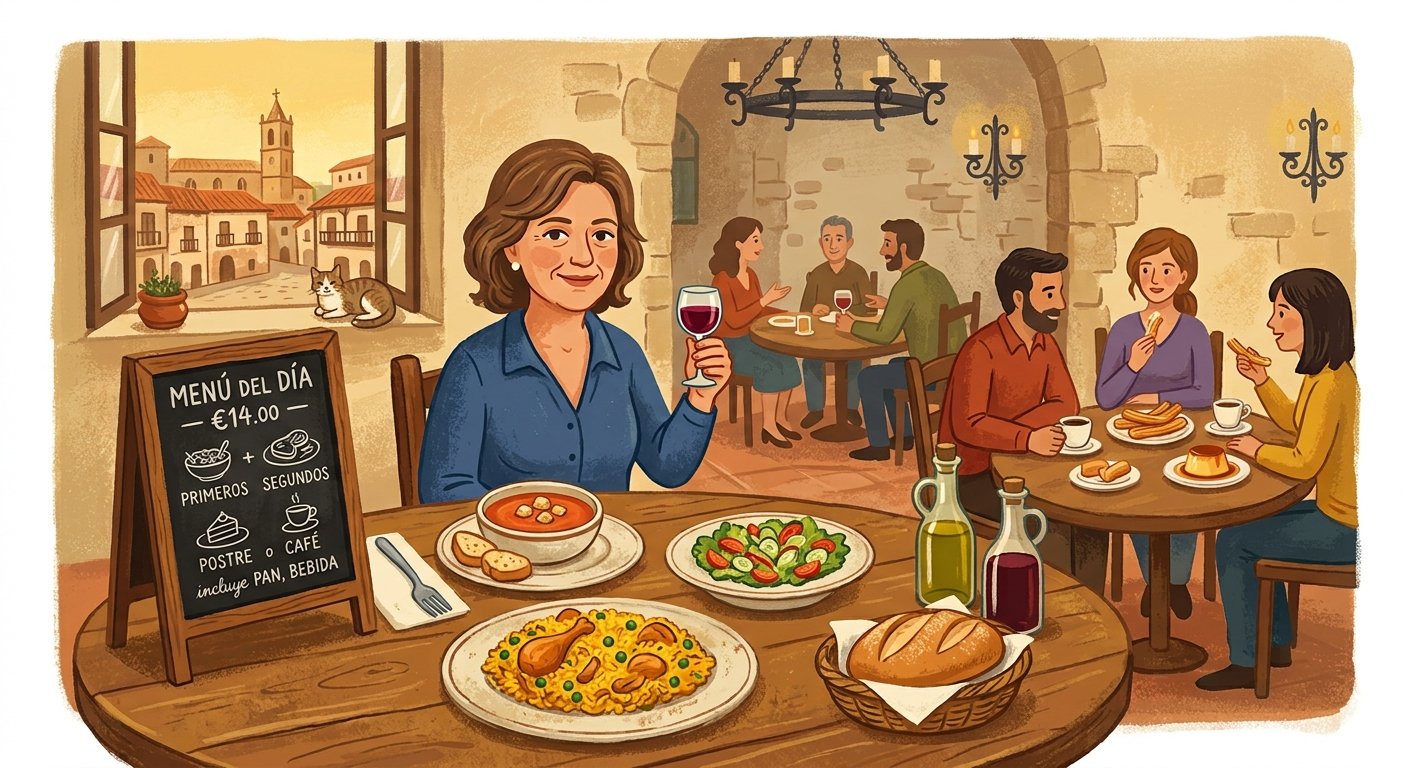
At lunchtime in Spain, you do not always need to study a long menu or choose three separate dishes. Sometimes the best option is simply to look for three words: menú del día. A set lunch arrives with several courses, bread, a drink, and dessert or coffee, usually for a fixed price.
The idea sounds simple, but the menú del día tells you a lot about Spanish food culture. It turns an ordinary weekday lunch into a proper meal, gives restaurants a way to showcase everyday cooking, and lets diners eat dishes that change with the season and the local kitchen.
A Full Meal in the Middle of the Day
The menú del día traditionally revolves around lunch, which remains the most substantial meal of the Spanish eating day. Spain’s official tourism material places lunch broadly between 2:00 and 4:00 p.m., reflecting the country’s later meal schedule.
A typical menu offers a choice of first course and second course, followed by dessert or coffee. Bread and a drink often come with the meal as well. The exact structure varies between restaurants, but the principle remains the same: you pay a set price and receive a complete lunch rather than ordering every component separately.
What Might You Find on the Menu?
This is where the menú del día becomes especially interesting. One restaurant might offer lentil stew as the first course, grilled fish as the second, and seasonal fruit to finish. Another might serve gazpacho, chicken, rice, and flan. The choices depend heavily on the restaurant, region, season, and ingredients available that day.
That variety is part of its appeal. These menus often feature familiar Spanish home-style dishes rather than elaborate restaurant creations. Lentils, stews, simple grilled meats, fish, rice dishes, vegetables, and pasta can all appear. Foods and Wines from Spain describes the format as a way to appreciate everyday dishes such as lentils, stews, rice dishes, and simply cooked meat and fish.
Why It Became So Popular
The menu of the day developed as a practical way for workers and ordinary diners to get a substantial meal at lunchtime. Restaurants could prepare dishes in larger quantities, while customers could enjoy several courses without paying the price of ordering everything individually.
Its popularity also reflects something fundamental about Spanish eating habits. Lunch is not traditionally treated as something to rush through at a desk. It can be a proper break in the middle of the day, with several courses and time to sit, talk, and eat. Spain’s official tourism guidance describes lunch as the most important meal of the day and encourages diners to take their time with it.
Thursday Might Mean Paella
There is even a curious tradition surrounding what appears on the menú del día. In many places, Thursday has long been associated with paella. The reason remains debated, with several explanations circulating, including traditions connected with older household and food-rationing routines.
Whether you encounter paella on Thursday or another day, the broader idea remains the same. Restaurants use the daily menu to work with familiar dishes and ingredients rather than offering exactly the same selection every day.
More Than a Bargain Lunch
It is tempting to think of the menú del día simply as an inexpensive way to eat well. Price certainly plays a role, but its cultural importance goes further.
The format gives everyday Spanish cooking a place in restaurants. A diner might encounter chickpeas, lentils, seasonal vegetables, a simple fish dish, or a slow-cooked stew that resembles something prepared in a family kitchen. The meal does not need to be luxurious to feel complete.
That is also why the menu can change with the seasons. Restaurants can build their daily choices around what is available and what suits the weather. A hearty stew makes sense on a cold day, while a lighter vegetable or seafood dish feels more natural when the weather warms.
The Spanish Lunch, Served as a Ritual
Sit down for a menú del día, and the experience can feel surprisingly generous. A starter arrives, then another plate follows, followed by something sweet and perhaps a coffee. Bread sits nearby, conversation continues, and the afternoon has not yet demanded that you rush away.
That is the real charm of Spain’s everyday feast. It takes ordinary food and gives it time and structure. You do not need a special occasion, a famous chef, or an expensive reservation. On an ordinary weekday, a restaurant can simply open its kitchen, put together the day’s best dishes, and invite you to sit down.


