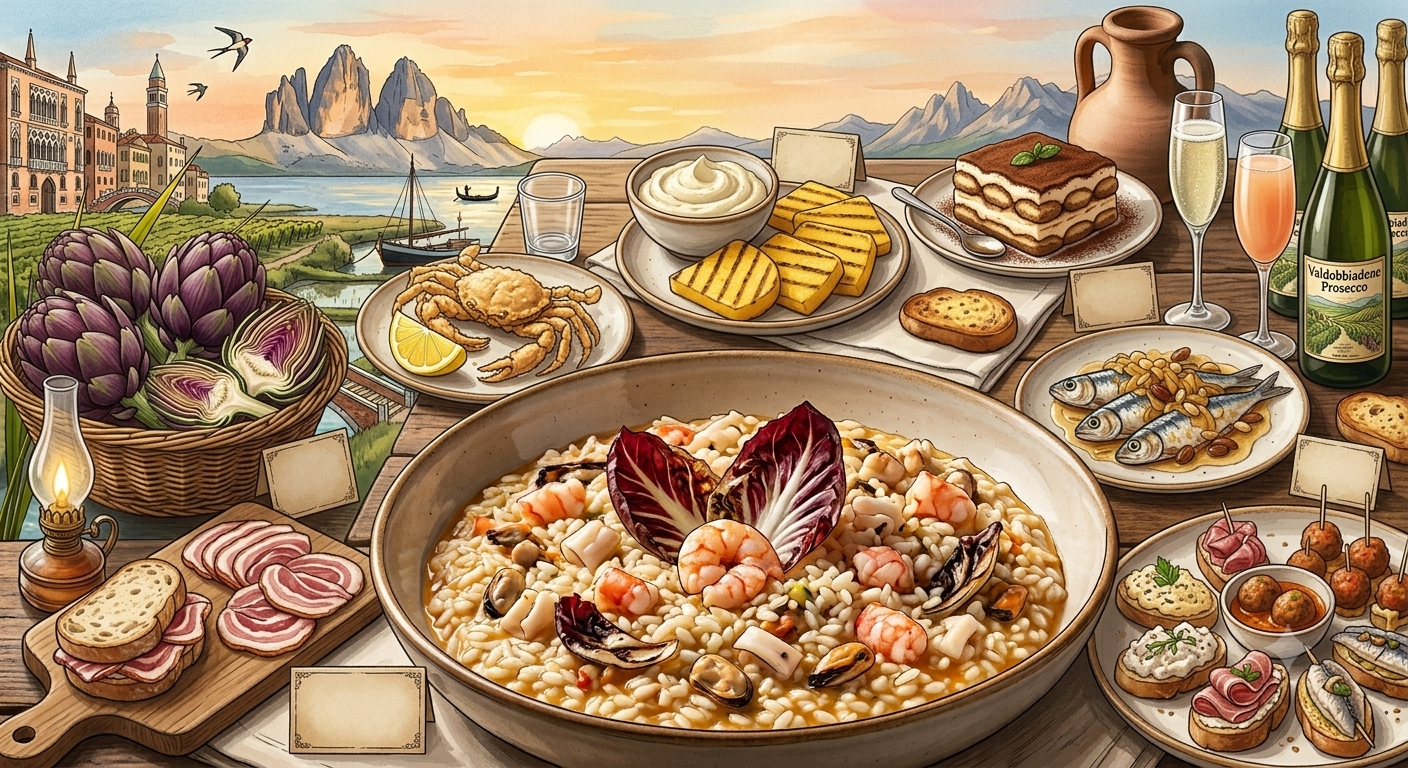
Venice tends to dominate any conversation about Veneto, but the region’s food reaches far beyond its famous lagoon city. Stretching from the Adriatic coast inland across fertile river plains, Veneto built a cuisine around three ingredients that, on paper, have little in common: seafood pulled from the lagoon and open sea, rice grown in flooded paddies further inland, and radicchio, a bitter leaf turned into something genuinely prized. Together, they reveal a region shaped as much by water — salt and fresh — as by any single culinary tradition.
Seafood: The Lagoon’s Daily Rhythm
Venice’s relationship with the sea is inseparable from its food, and the lagoon itself, rather than the open Adriatic, shapes much of what ends up on the plate. Small fish, cuttlefish, soft-shell crabs, and shellfish specific to the lagoon’s brackish waters appear constantly, prepared with techniques built around preserving delicate texture rather than masking it.
One of the region’s most distinctive seafood techniques is saor — a sweet and sour marinade of onions, vinegar, sugar, and pine nuts, traditionally poured over fried sardines and left to marinate for at least a day before serving cold. The technique dates back to Venice’s era as a trading empire, when fishermen needed a way to preserve their catch for longer voyages without refrigeration; the acidity and sugar acted as a natural preservative, and the dish has endured as a beloved specialty long after refrigeration made it unnecessary. Baccalà, dried salted cod rehydrated and whipped into a smooth, creamy spread called baccalà mantecato, represents a similar preservation-driven tradition turned into a genuine delicacy, requiring patient soaking over several days followed by careful, slow emulsification with olive oil.
Rice: An Unlikely Italian Staple
While much of Italy built its identity around pasta, Veneto’s cuisine leans heavily on rice instead, a legacy of the region’s flooded river plains, which proved ideal for rice cultivation centuries ago. Vialone Nano, a short-grain variety grown specifically in the Veneto countryside, is prized for its high starch content and its ability to absorb liquid without turning mushy, making it particularly well suited to risotto.
The technique behind Venetian risotto differs subtly from versions found elsewhere in Italy. Where many regions aim for a firm, distinctly separate grain, Veneto’s tradition favours all’onda — literally “wavy” — a looser, more fluid consistency achieved by adding stock a little more generously and stirring with slightly more vigour, so the finished dish ripples gently when the pot is tilted rather than holding a stiff mound. Risi e bisi, a spring dish of rice and fresh peas cooked to a consistency somewhere between a risotto and a soup, exemplifies this looser style particularly well.
Radicchio: Bitterness Turned into a Delicacy
Perhaps no ingredient better represents Veneto’s ability to transform something humble into something prized than radicchio, particularly the elongated, deep red variety grown around Treviso. Genuinely bitter when raw, radicchio might seem an unlikely candidate for regional pride, yet Treviso radicchio has earned protected status and a devoted following precisely because of how skilfully Venetian cooks handle that bitterness.
The key technique is heat. While radicchio appears raw in simple salads, its most celebrated preparations involve grilling or braising, which mellow its sharp edge and coax out a deeper, almost sweet, caramelised flavour underneath. Grilled radicchio, brushed simply with olive oil, develops a smoky char that balances beautifully against its natural bitterness. Braised gently with a little balsamic vinegar or wine, it softens further still, becoming an ideal partner for rich risottos, where its bitterness cuts through the dish’s inherent creaminess rather than fighting against it.
Veneto – A Region Balanced on Contrast
What ties seafood, rice, and radicchio together is Veneto’s broader comfort with contrast — sweet against sour in saor, starchy richness against bitter greens in a radicchio risotto, delicate lagoon seafood against the hearty, agricultural rice of the inland plains. It is a cuisine that rarely settles for a single dominant flavour, preferring instead to let opposing elements sit side by side on the same plate.
Risotto al Radicchio di Treviso
Serves 4
Ingredients
- 1.2 litres vegetable or chicken stock, kept warm
- 3 tbsp olive oil
- 1 small onion, finely diced
- 320g Vialone Nano or Carnaroli rice
- 150ml red wine
- 2 heads Treviso radicchio, sliced into thin ribbons
- 40g butter
- 60g grated Parmesan, plus extra to serve
- Salt and freshly ground black pepper
Method
- Heat the olive oil in a wide, heavy-based pan over medium heat. Add the onion and cook gently for 5 minutes until softened.
- Add the rice and toast for 1–2 minutes, stirring, until the edges turn slightly translucent.
- Pour in the red wine and stir until absorbed.
- Add the warm stock a ladleful at a time, stirring frequently and waiting until each addition is mostly absorbed before adding the next.
- After about 10 minutes, stir in most of the radicchio, reserving a small handful for garnish. Continue adding stock and stirring until the rice is tender but still has a slight bite, about 18–20 minutes total.
- Remove from the heat and beat in the butter and Parmesan vigorously, until the risotto turns loose and creamy, moving gently all’onda when the pan is tilted.
- Season to taste, top with the reserved raw radicchio, and serve immediately with extra Parmesan.