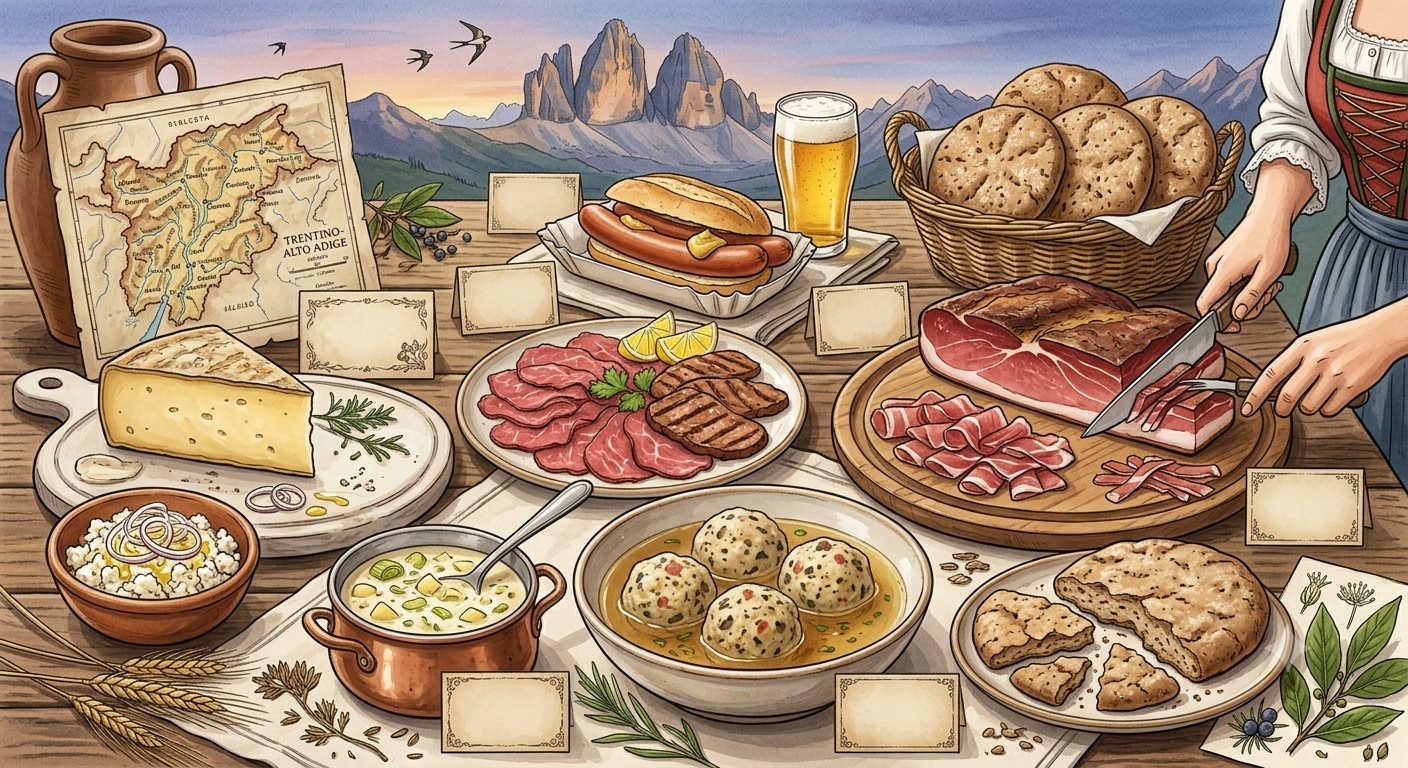
No region challenges the idea of a single “Italian cuisine” quite like Trentino–Alto Adige. Tucked against the Austrian border in the country’s far north, it is technically two provinces fused into one region, and its food reflects that split identity almost perfectly. Trentino, to the south, leans distinctly Italian in character. Alto Adige, known locally as South Tyrol, was part of Austria until after the First World War and still speaks German as its primary language in many towns — its food, unsurprisingly, tastes far closer to Innsbruck than Rome. Together, they form a genuinely alpine cuisine, built on cured pork, hearty dumplings, and mountain dairy rather than olive oil, tomatoes, or pasta in the way most people picture Italian food.
Speck: Curing Built for the Mountains
If one ingredient defines Alto Adige’s kitchen, it is speck — a smoked, cured ham entirely distinct from the air-dried prosciutto found further south. Where prosciutto relies purely on salt, time, and dry mountain air, speck adds a crucial extra step: cold smoking, traditionally over beechwood or juniper, which both flavours the meat and helps preserve it through the region’s harsher alpine winters.
The technique demands real precision. After salting and seasoning with juniper berries, bay leaf, and black pepper, the meat is smoked at a low temperature over several weeks, alternating with periods of air-drying in the mountain air. This combination — smoke plus dry-curing, rather than either alone — is what separates speck from its more southern cousins, giving it a firmer texture and a distinctly smoky, slightly resinous flavour that pairs naturally with the region’s rye bread and mountain cheeses.
Canederli: Bread Dumplings as a Way of Life
Nothing captures the region’s Austro-Italian fusion better than canederli, known in German as knödel — large, hearty dumplings made primarily from stale bread bound together with milk, egg, and speck or cheese. Much like Tuscany’s bread-based cucina povera dishes further south, canederli emerged from the same instinct to use up stale bread rather than waste it, though the result here is something far heartier, built to withstand cold alpine winters rather than a Mediterranean climate.
The technique is straightforward but requires a careful touch. Stale bread is torn into cubes and soaked in warm milk until softened but not mushy, then combined with egg, a binding flour, and mix-ins like diced speck, spinach, or cheese. The mixture is shaped by hand into firm balls and simmered gently in broth or salted water — too vigorous a boil breaks the dumplings apart, so a controlled, gentle simmer is essential. Served either floating in a clear broth or plated simply with melted butter and a scattering of chives, canederli exemplify the region’s broader approach: simple, filling food built for hard physical work in a cold climate.
Alpine Dairy: Cheese, Butter, and Mountain Pastures
Trentino–Alto Adige’s high alpine pastures support a dairy tradition unlike anywhere else in Italy. Where much of the country leans on olive oil as its primary fat, this region relies heavily on butter, and its cheeses — like the semi-hard, nutty Puzzone di Moena or the various alpine varieties collectively known as Tosela — are shaped by the specific grasses and altitude of the pastures where the cows graze, much like the terroir-driven cheeses of neighbouring Switzerland and Austria.
The technique behind alpine cheesemaking depends heavily on seasonal transhumance — moving cattle to higher pastures in summer and back down to the valleys in winter, a practice that directly shapes when and how the best cheeses are made. Many are aged in mountain huts or cellars, where the naturally cool, humid air replaces the need for climate-controlled facilities found in lower-altitude cheese production elsewhere in Italy.
A Region That Refuses to Choose
What makes Trentino–Alto Adige worth understanding is precisely its refusal to fit neatly into either Italian or Austrian tradition. A meal here might open with speck and mountain cheese, move through a bowl of canederli in broth, and close with a slice of apple strudel — a dessert borrowed directly from Vienna, given a light regional twist with the area’s celebrated apple orchards. It is Italian in geography and administration, but alpine and Germanic in spirit, and its food is stronger for embracing both rather than picking a side.
Canederli allo Speck (Speck Bread Dumplings)
Serves 4
Ingredients
- 300g stale white bread, cut into small cubes
- 200ml warm milk
- 100g speck, finely diced
- 1 small onion, finely diced
- 1 tbsp butter
- 2 eggs
- 30g plain flour, plus extra for shaping
- A handful of fresh chives or parsley, chopped
- Salt and freshly ground black pepper
- 1 litre beef or vegetable broth, for cooking and serving
Method
- Place the bread cubes in a large bowl and pour over the warm milk. Let soak for 15 minutes.
- Melt the butter in a small pan and sauté the onion until soft. Add the speck and cook for 2–3 minutes.
- Add the onion and speck mixture to the soaked bread, along with the eggs, flour, and chives. Mix well and season with salt and pepper.
- Let the mixture rest for 15 minutes, then shape into firm balls about the size of a tennis ball, using extra flour on your hands if needed.
- Bring the broth to a gentle simmer. Lower the dumplings in carefully and simmer, uncovered, for 15–20 minutes, until they float and hold together firmly.
- Serve in bowls of the broth, or drained and topped with melted butter and extra chives.