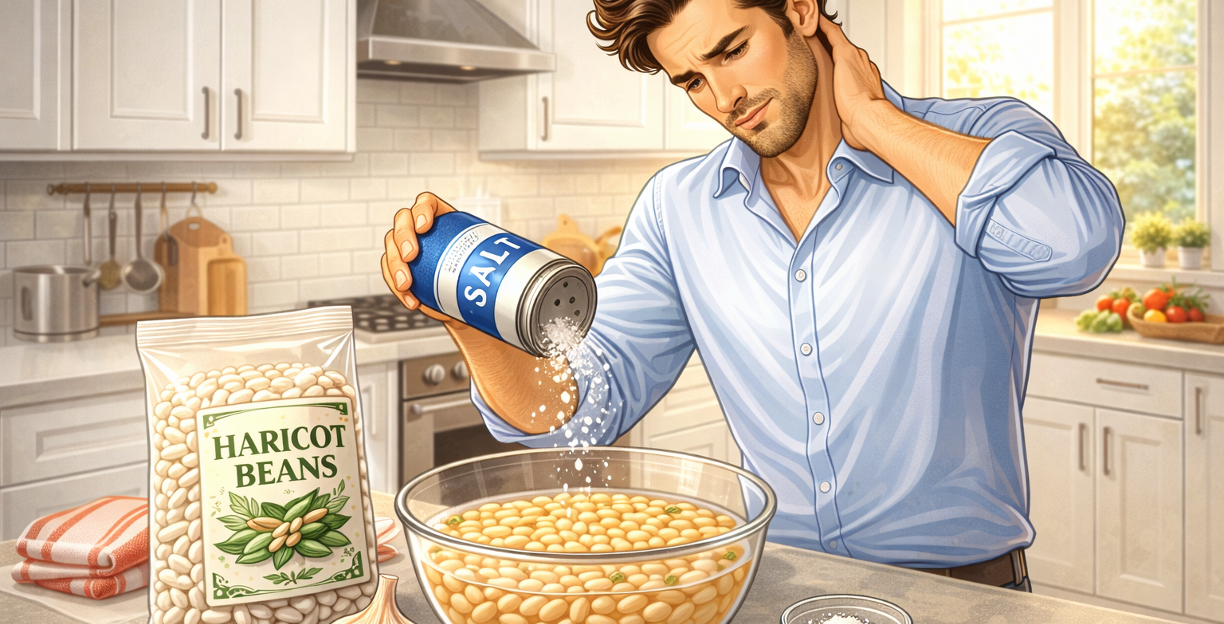
The “great salt debate” is a kitchen classic, often fueled by old wives’ tales and Grandma’s strict instructions. If you’ve been told that salting water early turns beans into tiny pebbles, it’s time to look at the molecular science. For decades, the conventional wisdom was to salt only at the very end. However, the heavyweights of food science—Harold McGee and Hervé This—have effectively debunked this, proving that early salting is the secret to the perfect legume.
The Chemistry of the Bean
In On Food and Cooking, Harold McGee explains that the primary barrier to a tender bean is the structure of its cell walls. These walls are held together by pectin, which is strengthened by magnesium and calcium ions. Think of these ions as the “glue” that keeps the bean’s skin rigid.
When you add salt (NaCl) to the soaking or cooking water, a beautiful bit of chemistry occurs:
- Ion Exchange: The sodium ions in the salt displace the magnesium and calcium ions in the bean skins.
- Softening: Because sodium ions are “weaker” binders than the minerals they replace, the pectin becomes more water-soluble.
- Efficiency: This chemical shift allows the skin to soften more quickly, letting water reach the starchy centre faster and more evenly.
Far from toughening the bean, salt actually prevents the dreaded “blowout”—where the insides turn to mush while the skin remains stubbornly crackly.
Flavour and Diffusion
Molecular Gastronomist Hervé This approaches the kitchen like a laboratory. He focuses on the movement of molecules, specifically how salt moves into the bean via diffusion.
If you salt at the end of the cooking process, the salt molecules only have time to coat the exterior. The result? A bean that tastes salty on the tongue but remains bland and starchy in the centre. By salting the water early (or better yet, during the soak), you allow the salt to migrate into the innermost cells of the bean as they hydrate. This results in a “seasoned-to-the-bone” flavour profile that late-salting simply cannot replicate.
The True Culprits: Acid and Hard Water
If salt isn’t the villain, why do beans sometimes stay hard? Science points to two real enemies:
- Acidity: Adding tomatoes, wine, or lemon juice too early is the ultimate mistake. Acid keeps pectin stable and insoluble, meaning no matter how long you boil them, those beans will stay crunchy.
- Hard Water: Water high in calcium and magnesium reinforces the bean’s “glue.” If your tap water is hard, even salt might struggle to soften the skins.
In short: Salt early, salt often, and leave the lemon juice for the garnish. Your beans will be creamier, tastier, and perfectly intact.
Since we’ve settled the science, it’s time to put those sodium ions to work. This recipe utilizes the McGee/This method: a salted soak (brining) to tenderize the skins, followed by early seasoning to ensure the creamy interior is just as flavorful as the broth.
Recipe: White Bean & Rosemary Soup
This recipe focuses on Cannellini or Great Northern beans, which are notorious for “blowing out” if not handled with scientific precision.
The Brine
Soaking in salted water is the most important step for skin texture.
- Ingredients: 1 lb (450g) dried white beans, 2 tbsp salt, 4 quarts water.
- Action: Dissolve the salt in the water and soak the beans for at least 8 to 24 hours.
- The Science: The sodium ions displace the calcium in the pectin, ensuring the skins are supple before they ever hit the heat.
Ingredients
-
- 3 tbsp Extra Virgin Olive Oil
- 1 large onion, diced
- 2 carrots, diced
- 4 cloves garlic, smashed
- 2 sprigs fresh rosemary
- 1 tsp red pepper flakes
Method
- Step 1: Drain and rinse your brined beans (this removes excess surface salt).
- Step 2: In a heavy pot, sauté your vegetables in olive oil until soft. Add the garlic, rosemary, and red pepper flakes until fragrant.
- Step 3: Add the beans and 6 cups of fresh water (or low-sodium stock).
- Step 4: Add 1 tsp of salt now. Even though you brined them, seasoning the cooking liquid ensures the flavor stays consistent as the starch swells.
- Step 5: Simmer gently for 45–60 minutes. Do not boil vigorously; a gentle movement in the water prevents physical damage to the softened skins.
The Acid Finish
Warning: Do not add these until the beans are “smash-against-the-roof-of-your-mouth” tender.
- Final Touch: Stir in 1 tbsp of fresh lemon juice or a splash of sherry vinegar.
- The Result: The acid brightens the heavy starches and “sets” the texture so the beans don’t turn into mush as they sit in the fridge.
Why this works
By the time you sit down to eat, you’ll notice two things:
- Uniformity: Every bean is intact, yet creamy.
- Depth: The bean itself tastes “savory,” not just the liquid surrounding it.