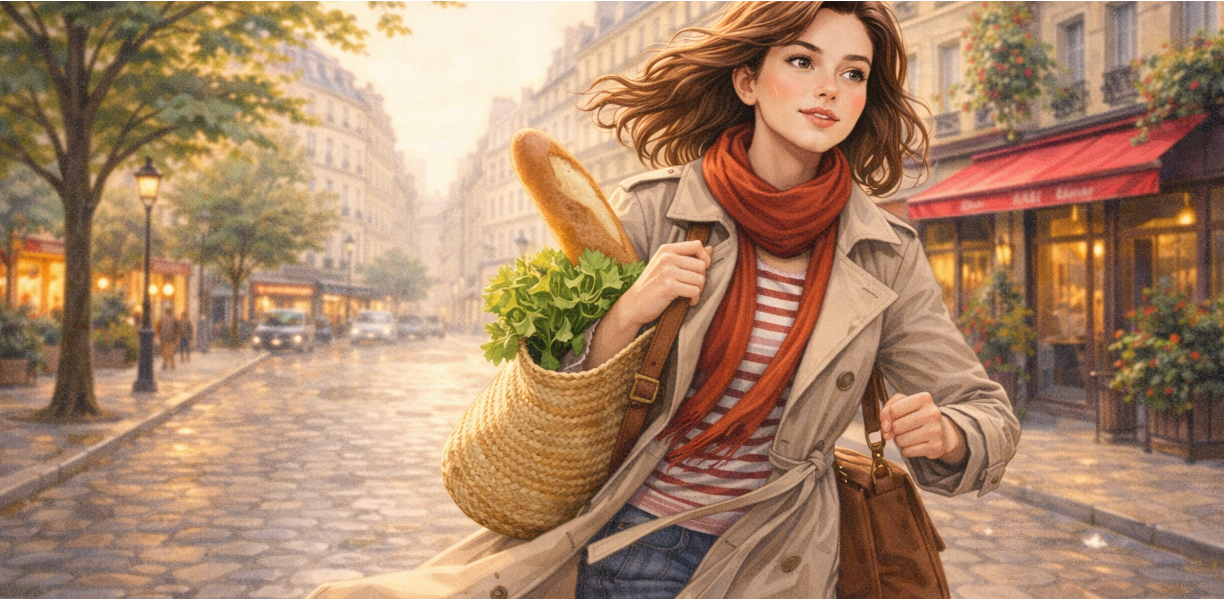
Walk through any French town in the early morning, and you will witness the same quiet, beautiful ritual. The light is still soft. The streets are waking up. And then you see them: people stepping out of their doorways, often still in soft clothes, coats thrown on hastily or forgotten entirely. They walk a short distance, and they return holding the long, thin paper sleeves that everyone recognises. Inside, still warm, is the bread.
This small errand is not shopping in the way we usually mean it; instead, it is a weekly stock-up or a trip to a supermarket. It is more like maintenance, like watering the plants on your windowsill or opening the shutters to let the morning in. It is simply what you do. The boulangerie is not there for special occasions. It is there for every single day.
Unlike the bright, humming silence of a supermarket aisle, the boulangerie runs on a different logic. It is built not around convenience, but around rhythm. The bread is expected to be fresh because it was made that morning, often just an hour ago. The baker’s schedule, written in flour and fire, quietly shapes the schedule of the entire neighbourhood.
Morning: The First Warm Loaf
The day at the boulangerie begins long before the first customer arrives. While the rest of the town sleeps, the baker is already at work. The dough was mixed the evening before, left to ferment slowly through the night, developing flavour in the darkness. By dawn, the ovens are roaring, and the first trays of baguettes emerge, golden and crackling.
The earliest customers arrive for breakfast. They buy bread that is still warm to the touch, sometimes pairing it with a croissant or a pain au chocolat, still glistening with butter. For a few minutes, the boulangerie becomes the breakfast kitchen for the entire street.
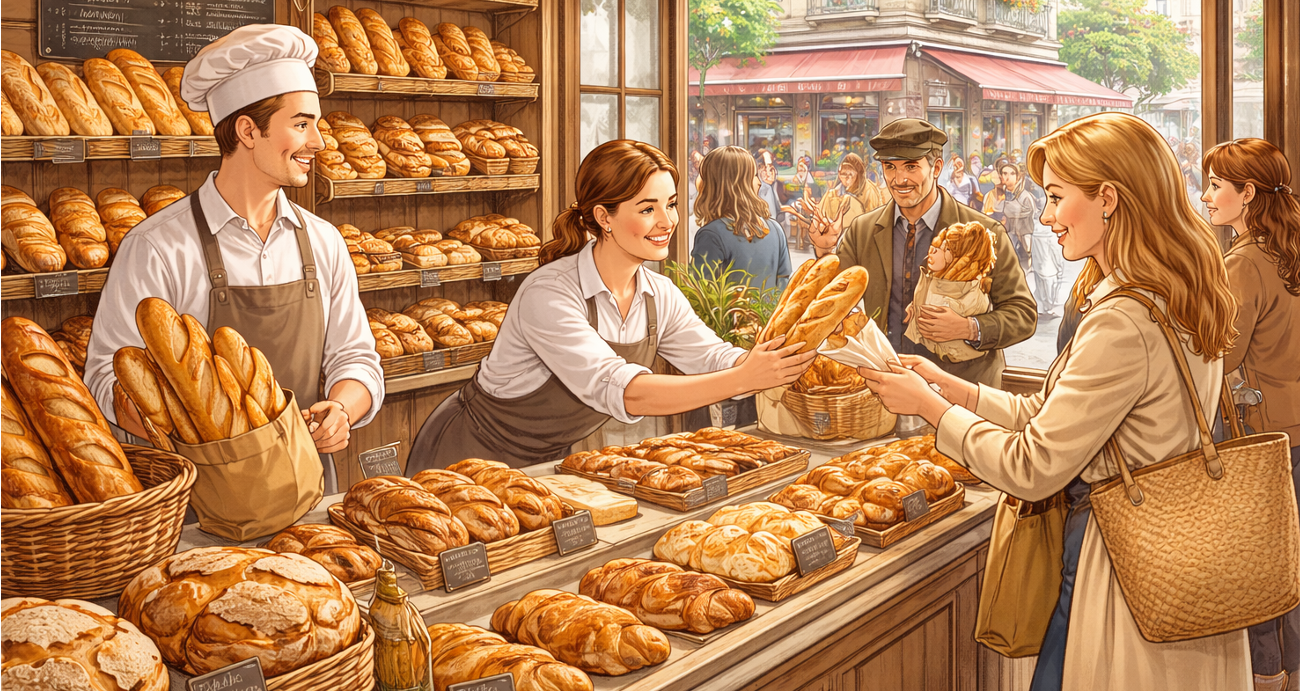
People rarely linger. There are no tables, no waiters. But in those brief exchanges—”Bonjour, Madame,” “Une baguette, s’il vous plaît,” “Merci, à demain”—a thousand small conversations happen. The baker knows who likes their crust a little darker. They know who is buying for two and who needs an extra loaf because the cousins are visiting for the weekend. Food and familiarity are braided together here, as naturally as the twist in a pain tressé.
Afternoon: The Second Act
By midday, a second batch of bread emerges from the ovens. This is essential because a French baguette is not designed for a long life. Its best hours are the first few, when the crust crackles, and the crumb is tender and fragrant. By evening, it has begun its quiet journey toward firmness, toward toast, toward a second life.
Many households, therefore, make the pilgrimage twice. A baguette for lunch. A baguette for dinner. It is not a chore; it is a cadence.
And the day-old bread? It is never wasted. The baker might grind it into fresh breadcrumbs, or dry it for stuffing, or use it as the foundation for a rich, cinnamon-scented pain perdu. The culture assumes transformation, not waste. Everything has a purpose, even yesterday’s loaf.
What a Boulanger Makes
A boulangerie is not just a baguette factory. It is a place that produces a whole range of wheat. Behind the glass, you will find:
- Crusty daily breads, the workhorses of the table
- Slow-fermented country loaves, darker and more complex
- Enriched breakfast pastries, golden with butter
- Savory bites—quiches, small pizzas, simple sandwiches
- Seasonal cakes and tarts, appearing and disappearing with the months
In principle, there is still a distinction between the boulanger (baker) and the pâtissier (pastry cook). But in the neighbourhood shops that matter most, the line is softly blurred. The goal is simple: a customer should be able to build a complete meal in one visit, from the first slice of bread to the last sweet bite.
The Space Itself
Step inside, and you will notice how deliberate everything is. The bread stands upright behind the counter, arranged like books on a shelf. There is no self-service here. You do not reach for your own loaf. You ask, and the baker selects. This small exchange is a form of quality control. The baker knows which loaf is at its perfect stage, which one has the ideal crust, which one will make you happy.
Notice, too, how the bread is handled. It is never thrust into a plastic bag. A simple paper sleeve protects the crust while allowing the bread to breathe. Steam escapes. The texture is preserved. It is a small, thoughtful act that treats the bread with the respect it deserves.
More Than a Shop
But the boulangerie is more than a place to buy bread. It is a social anchor, a quiet compass for the community.
New residents learn a neighbourhood here faster than anywhere else. You stand in line, you listen, you observe. You learn who is related to whom, who is ill, who has a new baby. Children stop by after school, clutching a few coins for a small treat. Elderly residents make the short walk each morning, maintaining a daily contact that is as much about human warmth as it is about food. A visitor can learn everything about a place simply by watching the orders.
In many ways, the boulangerie does what the café does in other cultures. It is not a place to sit for hours, but it is a place to recognise each other, to be seen, to belong.
The Lesson of the Boulangerie
The boulangerie, in the end, represents something essential about French food culture. It whispers a truth that is easy to forget in a world of weekly shops and long-life products:
Freshness is not a luxury. It is a routine.
Bread is made daily, not because it is fancy, but because daily life deserves good bread. The baker wakes in the dark so that a child can have a warm croissant before school. The dough ferments slowly so that a family can gather around a table at night and tear into something honest and nourishing.
The boulangerie is the daily heartbeat of French life. And if you listen closely, standing in that short morning line, you can feel it pulse.