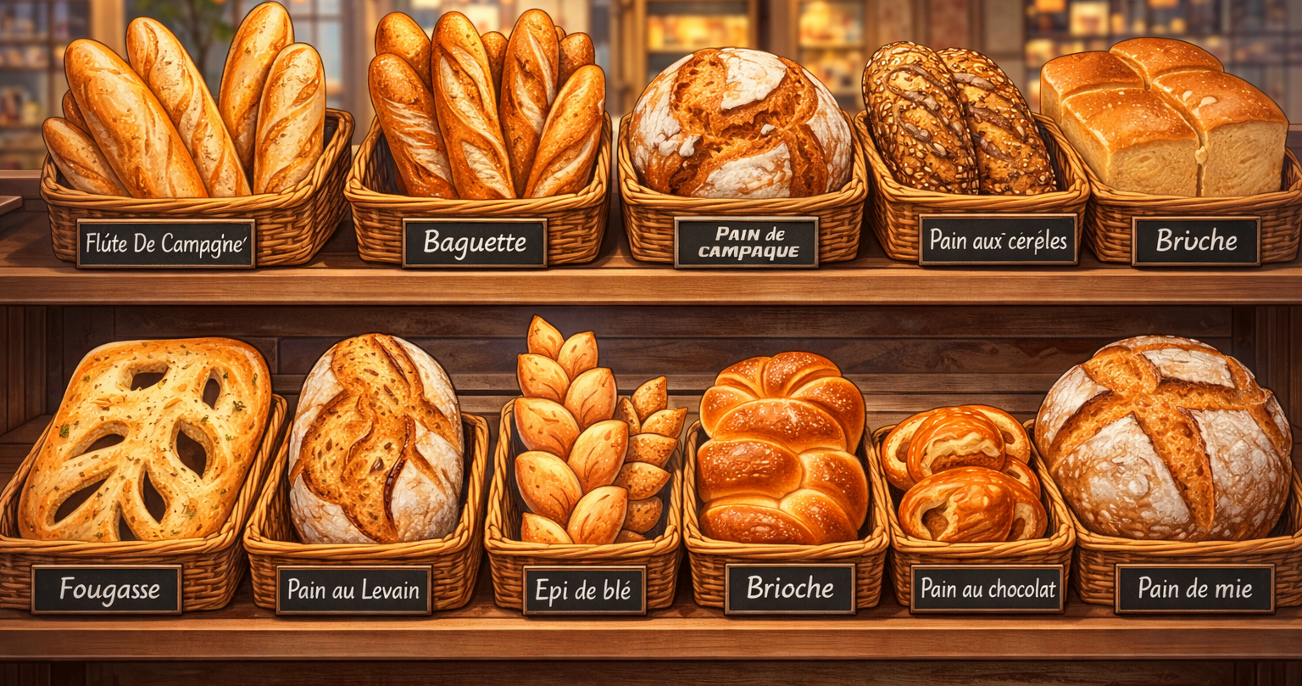
In France, bread is not a starter. It is not a garnish. It is certainly not a filler, something to bulk out a meal until the real food arrives.
Bread is the constant companion. It arrives at the beginning, stays through the middle, and lingers until the very last bite. Its role changes as the meal progresses, adapting to whatever the table needs. This is the one guest who is always welcome, who never overshadows the conversation, but without whom the whole evening would feel a little empty.
The Opening Gesture
Think of the beginning of a French meal. The table is set, the wine breathes, and a simple basket holds one or two baguettes at the centre. People don’t reach for a knife to slice it. They tear it by hand, a gesture that is both practical and deeply human. In some regions, a dish of butter might appear, but often they eat the bread just as it is—plain, floury, waiting. This moment matters. It sets the rhythm. It gives your hands something to do while you talk. The conversation starts here, long before the first course arrives.
Then the food comes, and bread becomes a tool. It is the thing that pushes a piece of terrine onto your fork. It is the perfect vehicle for gathering up the last of a vinaigrette. And at the end of a course, it performs the sacred ritual known as faire saucer—using a piece of bread to wipe the plate clean of sauce. In many cultures, this might be seen as a little too eager, a little too close to licking the plate. In France, it is the highest form of compliment. It says to the cook: I did not want to waste a single drop of your work.
From Tool to Structure
With a bowl of soup, bread transforms again. Think of a classic soupe à l’oignon, bubbling under a blanket of toasted bread and melted cheese. Here, the bread is not an afterthought; it is the very structure of the dish. It thickens, it absorbs, it becomes one with the broth.
When the main course arrives, bread plays a quieter, but equally essential role. It acts as the neutral friend who balances the richness of a long-simmered stew, the fattiness of a duck confit, and the tannins of a deep red wine. Its mild, wheaty flavour resets your palate, preparing you for the next delicious bite. French cooks understand that a great meal unfolds as a sequence of contrasts—hot and cool, rich and fresh, intense and plain. Bread serves as the quiet reference point against which everything else measures itself.
And then, of course, comes the cheese course. Here, bread reaches its most precise and noble role. A slice of pain de campagne, with its sturdy crumb and slightly sour edge, provides the perfect stage for a piece of Camembert or a crumble of Roquefort. It carries the cheese without competing with it. It supports, but never steals the show. Sweet breads, brioches, anything with sugar—they leave them for later. Here, the bread must act as a humble servant.
Only at dessert does bread finally step back. It disappears from the table, except in those wonderful dishes where yesterday’s loaf enjoys a second life—a slice of pain perdu (what we call French toast), or a simple tartine slathered with butter and jam.
The Varieties and What They Teach
French bread culture is not one single thing. It is a family of shapes, each with its own character and purpose:
- Baguette Tradition: The everyday hero. Fast fermentation, a crackling crust, meant to be bought daily and eaten within hours.
- Pain de Campagne: The country loaf. A mix of flours, a longer life, a flavour that speaks of old stone mills and hearth fires.
- Pain Complet: Whole grain, honest and nutritious, with a deeper, nuttier taste.
- Brioche: The rich cousin. Enriched with butter and eggs, it sits somewhere between bread and pastry, a treat for Sunday mornings.
- Ficelle: The thin one. More crust than crumb, for when you want that crackle in every bite.
- Boule: The round loaf. It ages slowly, its flavour developing over a day or two.
- Bâtard: The in-between. A shape that balances the crust of a baguette with the softer crumb of a larger loaf.
Each of these is a lesson in patience and craft. The baker controls the variables—hydration, fermentation time, proofing, the angle of the score—but they never rely on added flavourings. There is no sugar, no fat (except in brioche), no list of secret ingredients. French bread tastes of grain, of water, of air, and of time. It is a miracle of simplicity.
Bread in Daily Life
The French do not buy bread for the week. They buy it for the day, sometimes twice a day, walking to the boulangerie as naturally as breathing. Freshness is everything. The bread contains almost no preservatives, so its life is measured in hours. That first crackle when you break a warm baguette is a sound of pure joy. By evening, the crust has softened, but that is not a failure. Day-old bread is not waste. It becomes breadcrumbs for a gratin, toast for breakfast, or the base for that transformative pain perdu.
Even the simplest French sandwich, the jambon-beurre, is a study in balance. A good baguette, a layer of salted butter, a few slices of ham. That’s it. The magic is in the proportion. Too much filling, and the bread disappears, and the balance is lost. The bread must be felt.
French bread culture, in the end, teaches a lesson that goes far beyond the kitchen:
Food is not only what you cook, but also how you accompany it.
Bread is the thread that weaves through the meal, linking courses, textures, and appetites. Remove it, and the meal becomes a series of dishes, one after another. Keep it, and the meal becomes a conversation—one long, beautiful, unhurried conversation, with bread as the silent, steady partner at your side.