
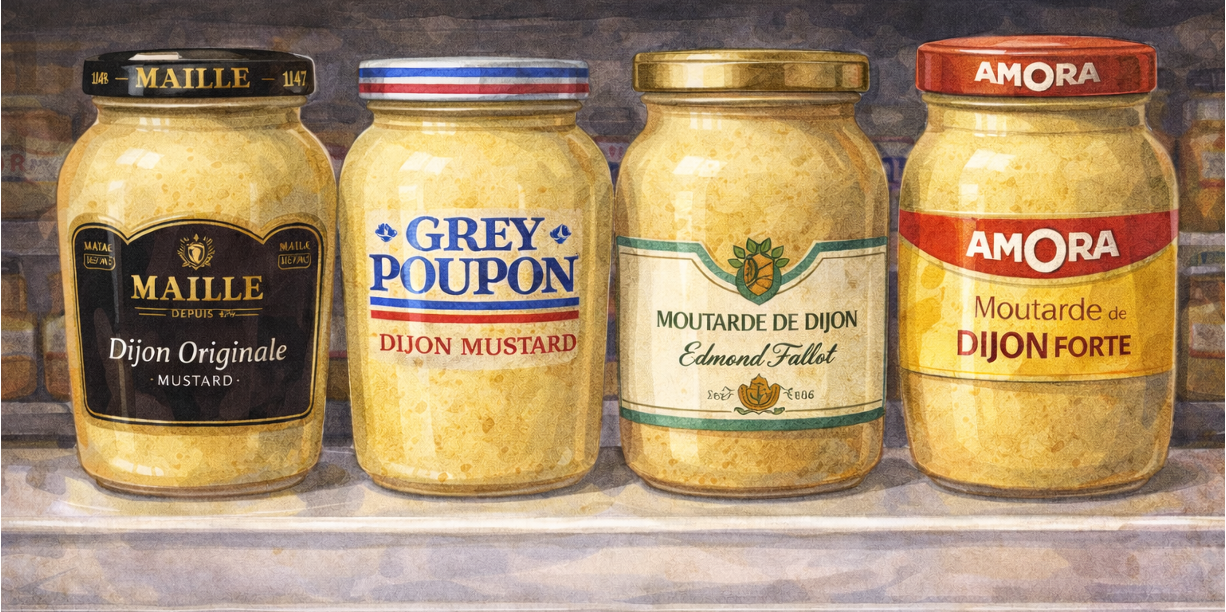
Sharp yet refined, bold yet balanced, Dijon mustard holds a unique place in the culinary world. Originating in the Burgundy region of France, this smooth, pale mustard is far more than a sandwich spread. It is a flavour enhancer, an emulsifier, a sauce base, and a quiet powerhouse in both classical and modern kitchens.
Understanding Dijon mustard means understanding how acidity, spice, and subtle heat work together. When used thoughtfully, it does not overpower a dish. Instead, it sharpens, brightens, and deepens flavour with remarkable precision.
What Is Dijon Mustard?
Dijon mustard is a smooth mustard made from brown or black mustard seeds blended with liquid — traditionally verjuice (the juice of unripe grapes), though modern versions often use white wine or wine vinegar.
Unlike wholegrain mustard, Dijon has a creamy texture and uniform consistency. It is stronger than yellow mustard but smoother and more elegant in flavour. The heat comes not from chilli, but from the natural compounds released when mustard seeds are crushed and mixed with liquid.
The result is sharp, slightly tangy, and gently spicy.
The History Behind Dijon Mustard
Dijon mustard originated in Dijon, a city in the Burgundy region of France. In 1856, a mustard maker named Jean Naigeon replaced vinegar with verjuice, creating a smoother, more complex mustard. This innovation shaped what we now recognise as classic Dijon.
Over time, Dijon mustard became essential in French cuisine, particularly in sauces, vinaigrettes, and marinades. Though the name refers to a style rather than protected origin today, traditional methods still emphasise quality seeds and balanced acidity.
The Science of Mustard’s Heat
Mustard’s sharpness is not caused by capsaicin, as in chillies. Instead, it comes from a chemical reaction between compounds in mustard seeds and liquid.
When seeds are crushed and mixed with water or wine, enzymes activate and produce allyl isothiocyanate — the compound responsible for mustard’s nasal heat. This sharpness is intense but short-lived, fading quickly compared to chilli spice.
Heat also diminishes when mustard is cooked. This is why Dijon tastes milder in creamy sauces than it does raw in dressings.
How Dijon Mustard Enhances Flavour
Dijon mustard performs multiple roles in cooking.
As a Flavour Enhancer
Its acidity sharpens rich dishes. A small spoonful added to cream sauces or stews prevents heaviness and balances fat.
As an Emulsifier
Dijon helps bind oil and vinegar together in vinaigrettes. The natural compounds in mustard stabilise emulsions, preventing separation.
As a Marinade Base
Mixed with herbs, garlic, and olive oil, Dijon forms a powerful marinade for chicken, pork, or vegetables.
As a Sauce Ingredient
It appears in classic sauces such as mustard cream sauce or béarnaise variations, adding subtle depth.
Using Dijon Mustard in Vinaigrettes
One of the simplest and most effective uses of Dijon is in vinaigrette.
Whisk together:
- 1 teaspoon Dijon mustard
- 1 tablespoon vinegar
- 3 tablespoons olive oil
- Salt and pepper
The mustard not only adds flavour but also stabilises the dressing. Without it, oil and vinegar separate quickly. With it, the dressing becomes creamy and cohesive.
This simple method demonstrates how Dijon contributes both chemistry and taste.
Dijon Mustard in Sauces
Dijon works beautifully in cream-based sauces. When stirred into warm cream and reduced slightly, it adds tang and gentle heat without overpowering.
It pairs particularly well with:
- Chicken
- Pork
- Salmon
- Potatoes
Because its sharpness softens during cooking, it integrates smoothly into the overall flavour profile.
Pairing Dijon with Other Ingredients
Dijon mustard complements many ingredients.
- With honey for sweet-and-savoury balance
- With white wine in pan sauces
- With herbs such as tarragon or thyme
- With garlic for marinades
- With yoghurt for lighter dressings
Its versatility makes it suitable for everyday cooking as well as refined dishes.
Common Mistakes to Avoid
Although easy to use, Dijon requires balance.
Adding Too Much – Its sharpness can dominate delicate dishes.
Cooking at High Heat Too Long – Prolonged high heat reduces its brightness.
Ignoring Salt Balance – Dijon contains salt, so adjust seasoning carefully.
Moderation ensures elegance rather than overpowering spice.
Dijon vs. Other Mustards
Dijon differs from other varieties in texture and flavour.
- Yellow mustard is milder and often sweeter.
- Wholegrain mustard contains visible seeds and more texture.
- English mustard is stronger and more pungent.
Dijon strikes a balance: smooth texture with assertive yet refined heat.
Why Dijon Remains Essential
In both professional and home kitchens, Dijon mustard serves as a reliable flavour tool. It improves sauces, strengthens dressings, and sharpens marinades without complexity.
It also represents a principle of French cooking: small ingredients can create significant impact. A teaspoon can change the character of an entire dish.
For cooks seeking to enhance flavour without heaviness, Dijon offers an elegant solution.
Final Thoughts: Sharp, Balanced, Timeless
Dijon mustard is more than a condiment. It is a technique ingredient — one that supports emulsification, flavour balancing, and sauce development.
From vinaigrettes to cream sauces, from roasted vegetables to grilled meats, its presence elevates dishes subtly but effectively. By understanding how it works and how heat affects it, you can use it with precision.
In the end, Dijon mustard proves that sophistication in cooking often begins with the simplest jar on the shelf.


