
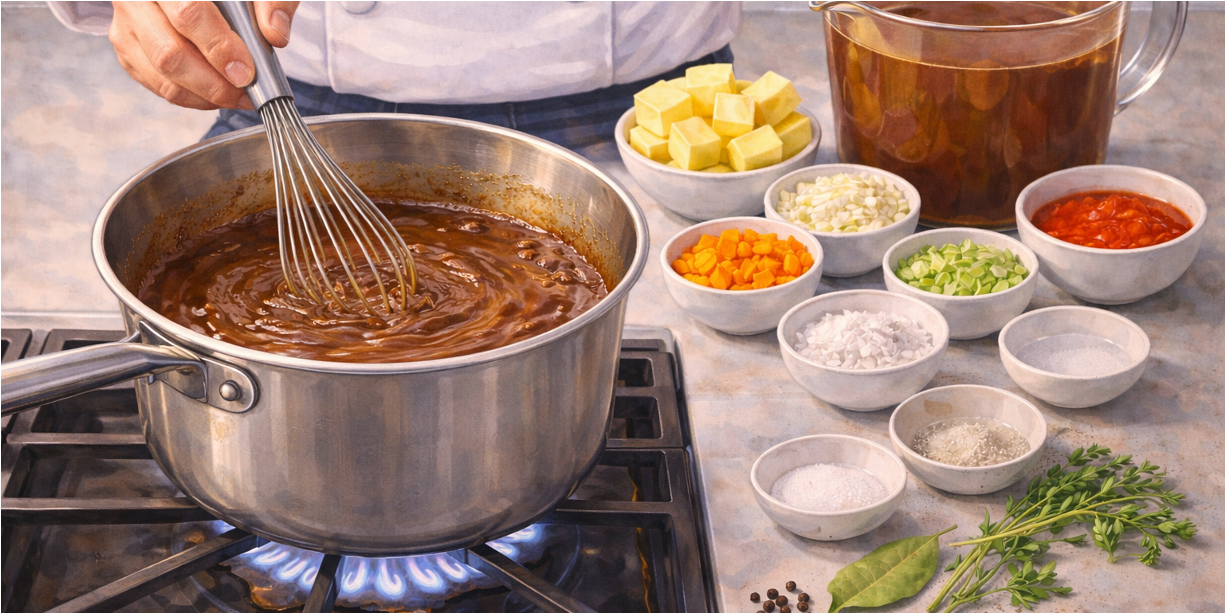
What Is Sauce Espagnole?
Sauce espagnole is one of the five classical mother sauces of French cooking. Dark, complex, and deeply savoury, it forms the foundation for many rich brown sauces. Unlike lighter sauces such as béchamel or velouté, espagnole carries bold flavour and colour, making it ideal for red meats and hearty dishes.
Although modern kitchens often simplify sauce preparation, classical French cooking treats espagnole as a vital building block. It rarely appears alone on the plate. Instead, chefs refine and reduce it further to create more elegant derivatives, the most famous being demi-glace.
Espagnole represents patience, technique, and the art of layering flavour over time.
The Origins of the Name
The name “espagnole” translates to “Spanish,” yet the sauce firmly belongs to French culinary tradition. Historians believe French chefs developed it during the 17th century, possibly influenced by Spanish ingredients such as tomatoes introduced through trade.
Over time, culinary masters such as Marie-Antoine Carême and later Auguste Escoffier formalised espagnole as a mother sauce. They refined its method and defined its place within the structured hierarchy of French cooking.
Despite its name, espagnole reflects French technique and precision.
The Core Components
Sauce espagnole relies on several key elements:
- Brown veal stock
- Brown roux
- Mirepoix (onion, carrot, celery)
- Tomato purée or paste
Each ingredient contributes a layer of flavour. The brown stock provides depth and a gelatin-rich body. The roux thickens and adds structure. Mirepoix introduces sweetness and aromatic balance. Tomato paste enhances colour and subtle acidity.
Unlike simpler sauces, espagnole demands multiple steps and careful timing.
The Role of Brown Roux
The roux used in espagnole differs from the pale roux in béchamel or velouté. Cooks prepare a brown roux by cooking butter and flour longer, allowing it to darken and develop a nutty aroma.
This deeper colour strengthens the sauce’s flavour and supports the intensity of roasted bones and vegetables. However, chefs must control the heat carefully. Burning the roux introduces bitterness and ruins the sauce.
In French cooking, mastery of roux defines strong foundational skills.
Building Flavour Through Roasting
Roasting plays a crucial role in creating espagnole. Cooks begin by roasting veal bones until deeply browned. This caramelisation produces complex, savoury notes through the Maillard reaction.
They often roast mirepoix alongside the bones to enhance sweetness and depth. Tomato paste may also caramelise briefly during this stage, intensifying its richness.
These roasted elements then simmer together in stock, gradually forming the base of the sauce. This process highlights how French cooking builds flavour step by step rather than relying on shortcuts.
Simmering and Skimming
Once combined, the sauce simmers gently for several hours. During this time, flavours blend and deepen. Cooks skim impurities from the surface to maintain clarity and refinement.
The slow simmer allows collagen from the veal stock to contribute body. The sauce thickens naturally, supported by the brown roux.
Patience remains essential. Rushing the process sacrifices complexity.
From Espagnole to Demi-Glace
Sauce espagnole rarely reaches the table in its original form. Instead, chefs reduce it further with additional brown stock to create demi-glace.
Demi-glace thickens into a glossy, concentrated sauce with intense savoury depth. It forms the backbone of countless classic sauces in French cooking, including bordelaise and chasseur.
This transformation demonstrates the hierarchical structure of classical sauce-making. It acts as a foundation, while demi-glace represents refinement.
Espagnole in Classical Dishes
Espagnole and its derivatives complement robust ingredients. They pair beautifully with beef, lamb, venison, and game.
In traditional French cuisine, chefs use these sauces to elevate roasted meats or enrich braised dishes. The sauce clings to the protein, adding depth without masking its character.
Its richness demands balance, which explains why French cooking often pairs it with vegetables or wine reductions to create harmony.
Modern Relevance
Although contemporary chefs sometimes prefer lighter sauces, espagnole still influences modern gastronomy. Many restaurants prepare simplified brown sauces inspired by its structure.
Even outside professional kitchens, understanding espagnole helps home cooks appreciate how flavour develops. The principles of roasting, reduction, and layering remain timeless.
By studying espagnole, cooks gain insight into the architectural approach that defines classical French cooking.
Common Challenges
Espagnole presents several challenges. Over-thickening can result from too much roux. Bitterness may occur if the roux burns. Cloudiness can appear if the sauce boils too vigorously.
Careful heat control, steady stirring, and patient skimming prevent these issues. Precision and attention to detail ensure a balanced final result.


