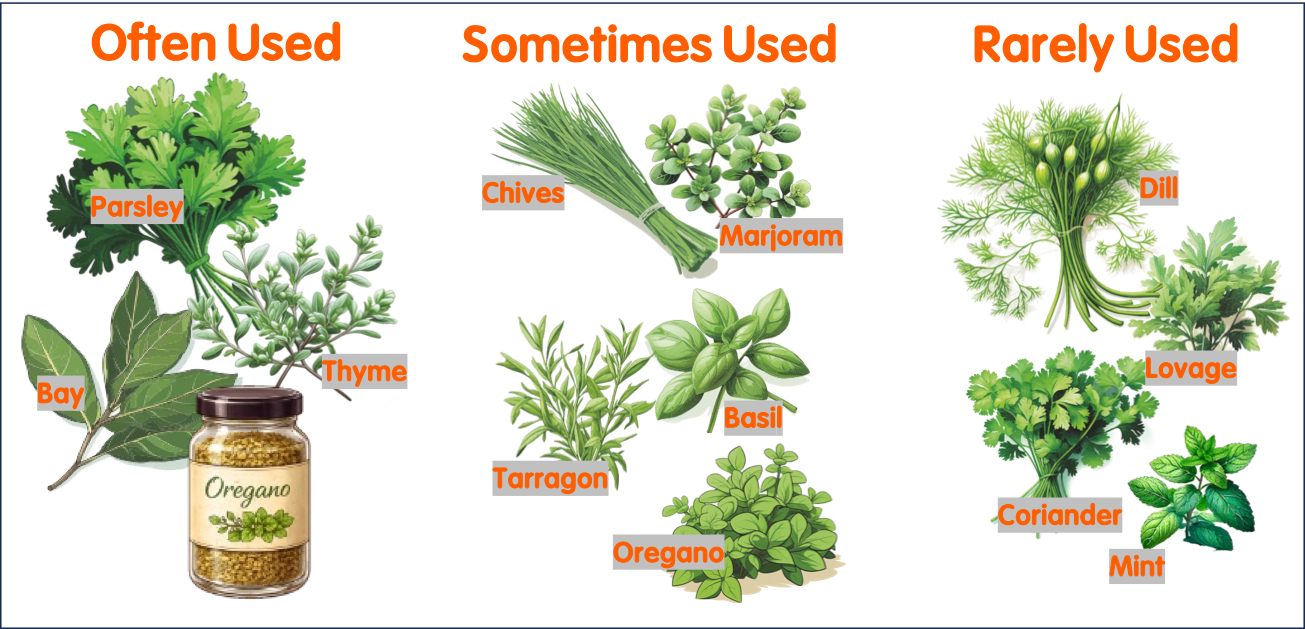
Spain sits in the herb belt of the Mediterranean, but Spanish cooking is not “herb-heavy” in the way some people imagine (a constant shower of mixed green herbs). Instead, herbs are used with specific jobs: to freshen a sauce, to perfume a long simmer, to balance vinegar, or to round out fat and garlic. If you understand the jobs, you’ll understand why some herbs are everywhere (parsley, bay leaf), while others are regional or occasional (coriander leaf/cilantro, hierbabuena/mint).
Below is a practical map: which herb, where it appears, and what it’s doing—with recipe examples when the herb is less common.
1) Parsley (perejil): Spain’s “default fresh herb”
How it’s used (very clearly):
- Finishing herb: chopped and added at the end for freshness, colour, and “clean edges”.
- Herb base in green sauces: blended or cooked into a sauce where parsley is the body, not garnish.
- With garlic: parsley often “softens” garlic’s sharpness.
Classic patterns and dishes
- Basque salsa verde (fish/shellfish): parsley is the defining flavour and colour in the sauce.
- Boquerones en vinagre (vinegar-marinated anchovies): parsley finishes the dish with garlic and oil.
- Pollo al ajillo (garlic chicken): commonly finished with parsley, which brightens a rich, garlicky pan.
Home-cook rule: If you’re cooking something garlicky, oily, or vinegary, parsley is the “reset button” you add at the end.
2) Bay leaf (laurel): aroma that survives long cooking
Bay leaf is used because it doesn’t collapse under time. It perfumes stews and braises without turning grassy.
How it’s used:
- Whole leaf, early: added at the start of a simmer so it infuses the liquid.
- Removed before serving: it’s a background note, not meant to be eaten.
Where you see it
- Bean stews like fabada: bay leaf quietly lifts porky, smoky richness.
- Pickling and escabeche: bay holds up to vinegar and oil, giving a savoury backbone.
Home-cook rule: If your dish simmers longer than 30 minutes, bay is one of the few herbs that still “shows up” at the end.
3) Woody hillside herbs: thyme (tomillo) and rosemary (romero)
These are the classic Mediterranean scrubland herbs. In Spain, they’re used less as “green sprinkle” and more as perfume under heat.
Thyme (tomillo)
How it’s used:
- In braises and roasting: thyme infuses fat and meat juices.
- In escabeche: thyme stands up to vinegar and improves the “pickled” aroma.
Examples
- Escabeche recipes often include thyme with bay.
Rosemary (romero)
How it’s used:
- Roasting herb: rosemary oils dissolve into lamb fat and roast juices.
- As branches/sprigs: used like a “scented plank”, then removed.
Examples
- Roast lamb recipes commonly pair romero + tomillo.
Home-cook rule: Use these herbs as sprigs, not chopped, for long cooking. Chop only if you want the herb to be tasted, not just smelled.
4) Oregano (orégano): dried herb with a Spanish accent
Spanish cooking often prefers dried oregano over fresh. Dried oregano reads as warm, slightly bitter, and savoury—excellent with tomato, vinegar, and grilled flavours.
How it’s used:
- In marinades and vinaigrette-style dressings.
- As a dry seasoning in acid-based preparations.
Example
- Some boquerones recipes include oregano alongside parsley, garlic, vinegar, and oil.
Home-cook rule: Add dried oregano early (so it rehydrates) or bloom it briefly in oil/vinegar mixtures.
5) When herbs are “rare” in Spain: regional pockets and specific dishes
Some herbs aren’t staples across Spain, but they appear strongly in certain regions or preparations. If you use them, it helps to do it in a Spanish way (with the right format and pairings), not by sprinkling them randomly.
Coriander leaf (cilantro): Canary Islands mojo culture
On the mainland, cilantro is far less central than parsley. But in the Canary Islands, cilantro can be a starring herb in mojo verde, the green sauce served with potatoes, fish, or grilled foods.
How it’s used (Spanish-Canarian logic):
- Blended with garlic, oil, vinegar, and spices → a sauce, not a garnish.
- The herb is supported by acid and garlic so it tastes “mojo”, not “salad”.
Hierbabuena (mint): specific stews and regional traditions
Mint isn’t a universal Spanish herb, but it appears in certain traditional contexts—especially where legumes, vegetables, and paprika are involved. For example, a Murcian-style bean-and-veg preparation references hierbabuena as a characteristic flavour.
How it’s used:
- Added towards the end or infused gently so it stays aromatic.
- Acts like a fresh, cool top-note in otherwise earthy dishes.
Home-cook rule for “rare” herbs: Only use them when the dish structure expects them (like mojo verde or specific regional stews). Otherwise they can read as “non-Spanish” very quickly.
6) The big technique takeaway: Spain uses herbs by format
If you want Spanish results at home, think in formats:
- Finishers (fresh chopped)
Parsley is the prime example—added at the end to brighten. - Infusers (whole sprigs/leaves)
Bay, thyme, rosemary: added early, removed later. - Sauce herbs (herb becomes the sauce)
Salsa verde (parsley) and mojo verde (cilantro/parsley variants): herb is the main event, processed into a sauce. - Acid partners (herbs that stand up to vinegar)
Bay + thyme in escabeche; oregano in vinegary marinades.
A quick “Spanish herb decision” cheat-sheet
- Cooking garlic + oil? Finish with parsley.
- Cooking beans or long stews? Add bay leaf early.
- Cooking roast lamb / hearty roasts? Use rosemary + thyme sprigs.
- Cooking escabeche? Think bay + thyme (and sometimes oregano).
- Want something distinctly Canarian? Make mojo verde with cilantro.