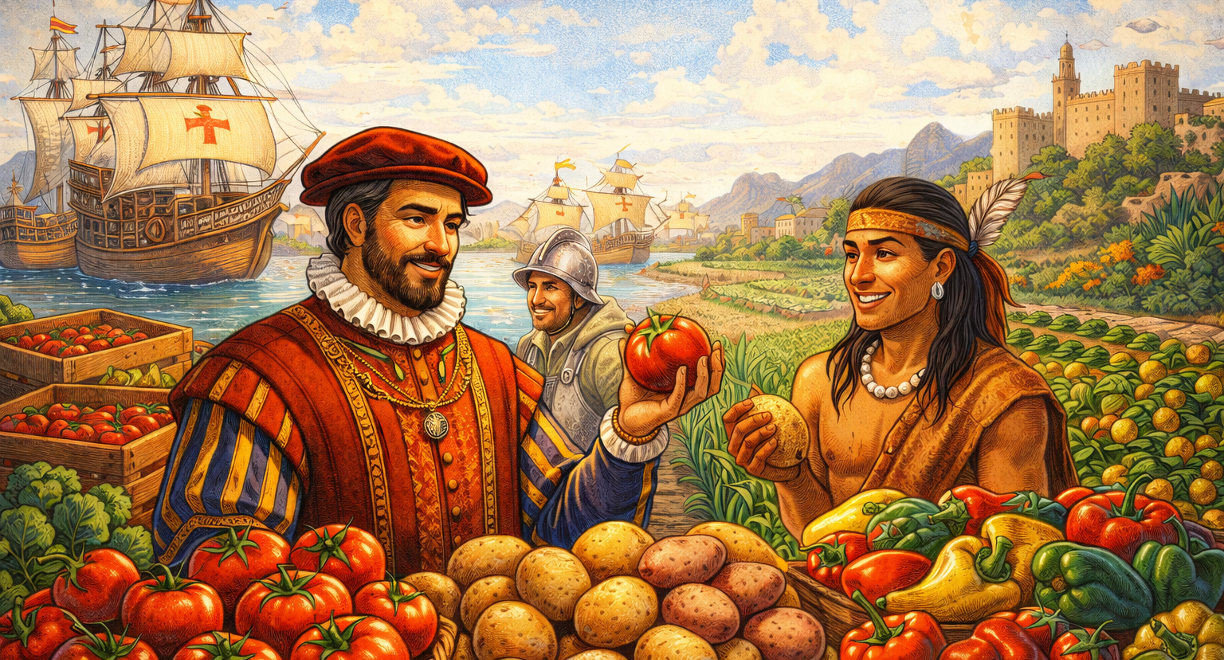
When Spaniards first crossed the Atlantic in 1492, they did not just return with gold, silver, and stories — they returned with plants that would quietly, and then dramatically, reshape their kitchen. What we now think of as “traditional” Spanish food is, in fact, deeply marked by the encounter with the Americas. Tomatoes, peppers, potatoes, chillies, cacao, vanilla, and maize are some of the most important New World Ingredients that arrived slowly at first, then became so embedded in daily life that their foreign origins are often forgotten. These New World Ingredients changed the Spanish kitchen forever.
In the late 15th and early 16th centuries, Spain acted as Europe’s gateway to the New World. Ships docked in Seville, Cádiz, and later Barcelona, carrying not only treasure but botanical curiosity. Yet these ingredients did not transform Spanish cooking overnight. They were met with suspicion, adaptation, and gradual experimentation. Some were first grown as ornamental plants; others were used medicinally before they were eaten. Ultimately, Spanish cuisine began to embrace many ingredients of the New World, such as those that later became known as New World Ingredients, in unique ways.
The tomato: from curiosity to foundation
Perhaps the most revolutionary arrival was the tomato. Early modern Europeans found it strange — bright, acidic, and unlike anything they knew. In Spain, it took centuries to become fully accepted, but once it did, it changed everything. Clearly, the tomato is now a central New World ingredient in Spanish cuisine.
Today, tomatoes underpin some of Spain’s most iconic dishes: gazpacho, salmorejo, sofrito, and countless stews. The idea of grated tomato fried gently in olive oil — the base of so many Spanish sauces — is a direct legacy of culinary discoveries from the New World. What feels ancient in Spanish cooking is, in fact, only a few hundred years old because of the influence of New World Ingredients.
Peppers, pimentón, and heat
Chillies and sweet peppers arrived alongside tomatoes, but their impact followed a different path. In regions like Extremadura and La Vera, peppers were dried and smoked to make pimentón, now indispensable to Spanish cuisine. Peppers are yet another example of New World ingredients shaping Spain’s culinary identity.
Pimentón transformed dishes such as pulpo a la gallega, chorizo, and many rustic stews. It gave Spain a distinctive smoky warmth that had no equivalent in pre-Columbian Europe. Importantly, Spanish cooks preferred fragrance over raw heat — a subtle but defining choice that set these New World Ingredients apart.
The potato: a quiet revolution
The potato was initially mistrusted in Europe, yet in Spain it gradually became a staple of everyday life. By the 18th century, it had entered both humble and refined kitchens as yet another example of a transformative New World Ingredient.
Dishes like tortilla española, patatas bravas, and countless stews are unthinkable without potatoes. What makes this transformation remarkable is that Spain already had grains and pulses — yet the potato offered something new: reliability, versatility, and comfort. This demonstrates how essential New World Ingredients have become in Spanish staples.
Maize, beans, and changing textures
Maize (corn) arrived with great promise but never replaced wheat or rice in Spain as it did in parts of the Americas. Instead, it found niche uses as a New World ingredient in regional breads and rural cooking.
Beans — especially varieties brought from the Americas — slowly expanded Spain’s pulse repertoire. Over time, they blended with older Mediterranean legumes like chickpeas and lentils, enriching the Spanish tradition of hearty, sustaining dishes. In this way, the impact of New World Ingredients was subtle yet far-reaching.
Cacao and the birth of Spanish chocolate
One of the most luxurious New World gifts was cacao. Spaniards were among the first Europeans to embrace chocolate, initially as a spiced drink rather than a sweet bar. Cacao stands as a prized New World Ingredient in Spanish food history.
Hot chocolate in Spain evolved into something thick, almost spoonable, often served with churros. This ritual — rich, comforting, communal — is now woven into Spanish café culture, thanks to the arrival of New World ingredients such as cacao.
A two-way exchange
What is fascinating is that Spain did not simply adopt these ingredients — it transformed them. Tomatoes became Mediterranean rather than tropical. Chillies became smoky rather than fiery. Potatoes became home cooking rather than exotic novelty. Moreover, the legacy of New World Ingredients extends beyond Spain, marking a global culinary impact.
Equally, Spain sent its own foods back to the Americas: olive oil, wheat, citrus, wine, and livestock. Spanish and New World cuisines grew together, creating a global food system that still shapes how we eat today, with countless New World Ingredients present in contemporary dishes.
Rethinking “tradition”
The lesson of New World ingredients is that tradition is never static. What feels timeless in Spain — gazpacho, tortilla, sofrito, pimentón — is actually the product of encounter, curiosity, and adaptation. For this reason, these New World Ingredients continue to define Spanish food culture and influence what it means to be “traditional.”
Spanish cooking is not ancient in a frozen sense; it is ancient in its capacity to absorb, reinterpret, and make foreign things its own. That flexibility is perhaps its greatest strength, shaped by centuries of encounters with New World Ingredients.
When you bite into a tomato salad, dip bread into smoky chorizo oil, or sip thick chocolate, you are tasting not just Spain — but the legacy of an ocean-crossing exchange that brought New World Ingredients and remade the world’s kitchens.