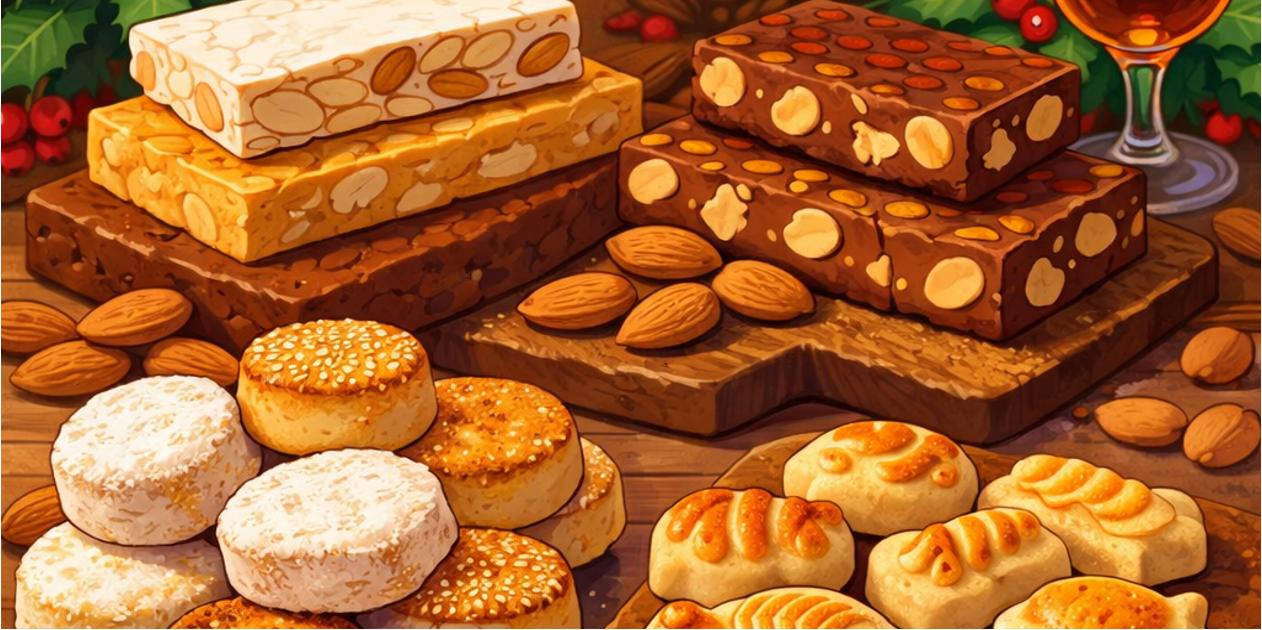
If you walk into a Spanish home in December, the first thing you are likely to see is not a Christmas tree, but a long slab of turrón wrapped in thin paper, waiting to be broken at the table. In Spain, sweets do not merely end a meal — they carry memory, ritual, and family history.
Turrón is often described simply as an almond-and-honey confection, but that description hides its cultural depth. The most revered turrón comes from Jijona (Alicante), where generations of artisans have perfected two canonical styles: Turrón de Jijona (blando, soft) and Turrón de Alicante (duro, hard). Both begin with the same triumvirate — toasted almonds, pure honey, and whipped egg whites — yet technique creates entirely different textures. The soft version is ground to a silky paste, almost like a rustic marzipan spread. The hard version is poured hot between two sheets of edible wafer, cooling into a crisp, brittle slab that shatters cleanly when snapped.
Moorish Past
Historically, turrón is a direct inheritance from Spain’s Moorish past. Across medieval North Africa and Al-Andalus, honey-and-nut sweets were prized for their shelf life, energy, and luxury. Over centuries, Spanish confectioners refined these ideas into something distinctively Iberian — less floral than Middle Eastern halva, more nut-forward, with a gentle citrus perfume.
Yet turrón is only one star in Spain’s festive constellation. On Christmas tables you will also find polvorones (crumbly almond shortbreads that dissolve almost instantly on the tongue), mantecados (rich biscuits made with lard or olive oil), and hand-moulded mazapán figurines shaped like fruit or saints. In Andalusia, these sweets tend to carry warm spice and orange blossom; in Castile they are richer and more buttery; in Valencia, almonds dominate everything.
What unites them is balance. Spanish festive sweets are sweet, but rarely cloying. Toasted nuts, citrus zest, and a whisper of cinnamon keep the flavour grounded. They are meant to be eaten slowly with coffee, sherry, or cava — and, crucially, shared.
In many families, a single piece of turrón circulates around the table rather than everyone taking their own. Breaking and passing becomes part of the celebration, reinforcing the idea that sweetness belongs to the collective, not the individual.
Homemade soft-style turrón (Jijona-inspired)
Ingredients
- 250g whole almonds, lightly toasted
- 150g clear honey
- 120g icing sugar
- 1 free-range egg white
- Zest of ½ lemon
- Pinch of fine sea salt
Method
- Grind the warm toasted almonds in a food processor until they form a smooth, oily paste. Stop and scrape often — patience matters.
- Warm the honey gently until fluid but not bubbling.
- Whisk the egg white to soft, glossy peaks.
- Fold almond paste, honey, icing sugar, lemon zest, and salt together until uniform.
- Press firmly into a lined small loaf tin, smoothing the top.
- Chill for at least 6 hours (overnight is better).
- Slice thinly and serve at room temperature.
This turrón keeps for two weeks in the fridge, but in most Spanish homes it rarely lasts that long. Each slice carries not just flavour, but a quiet reminder of history, harvest, and togetherness — which is, ultimately, what Spanish festive cooking is about.