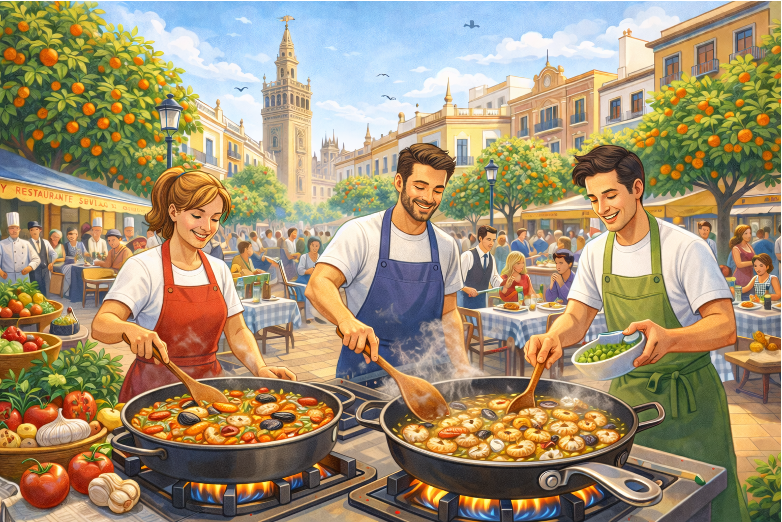
Spanish cooking is often summarised in one word: fiesta. But that word flattens something far richer. What looks celebratory and generous on the table is the work of centuries — of geography, scarcity, trade, conquest, and migration, and above all of a fiercely local relationship to ingredients. If Italian cooking is about clarity, Spanish cooking is about place. Every plate carries its landscape: the olive groves of Andalucía, the wheat of Castilla, the Atlantic cliffs of Galicia, the rice lagoons of Valencia, the sheep pastures of La Mancha. You taste it in pan con tomate, in paella valenciana, in pulpo a la gallega, and in slow-roasted cordero asado, where land and fire speak together. Two forces echo through every chapter that follows: the Moorish inheritance of al-Andalus in almonds, citrus, and irrigation, and the New World ingredients — tomato, pepper, potato, chocolate — that remade the table after 1492.
A Country of Regions
Spain is not one cuisine but seventeen, and the surest way to understand it is region by region. The north opens with Galicia’s Atlantic larder1 and its seafood traditions, the sea-and-mountain identity of the Basque Country2, and Asturian cooking built on cider and beans3. The Mediterranean arc runs from Catalonia’s layered cuisine through the rice heartland of Valencia4 and the orchard cooking of Murcia5. The interior holds the wood-oven roasts of Castilla6, the cheese-and-saffron country of La Mancha7, the mountain plains of Aragón8, the vegetables and wine of Navarre and La Rioja9, and the ibérico and dehesa of Extremadura10. Andalucía, explored in its tradition and modernity, anchors the south, while the islands add the volcanic table of the Canaries11 and the island cooking of the Balearics12. Underneath them all run the deeper cultural influences on Spanish food.
Oil, Smoke, and the Spanish Larder
At the centre of the kitchen lies oil. Spanish olive oil culture is not a technical detail but the flavour of the country itself, and it carries the smoke of pimentón de la Vera, the perfume of Spanish saffron, and the acidity of sherry vinegar. Stock the pantry further with roasted piquillo peppers13, the dried ñora and choricero14 that colour so many sauces, the regional chillies of Spain, and Marcona almonds15 alongside the wider tradition of Spanish almonds and nuts in cooking. Learn how to grade and toast saffron16, how to build choricero pepper paste17, and — wherever you live — how to shop for Spanish ingredients.
Bread and the Everyday Loaf
Bread frames every Spanish meal. Spanish bread culture runs from rustic pan de pueblo to the airy, glass-crumbed pan de cristal, the loaf built for scooping sauces and rubbing with tomato. Bread is never wasted, either — stale crumbs become the shepherd’s migas18, and day-old loaves thicken the cold soups of the south.
The Rice Kitchen
Rice is Spain’s great canvas, and paella only its most famous face. Everything begins with bomba rice and absorption cooking, the prized socarrat crust at the base of the pan, and the science of saffron and rice chemistry underpinned by good stock and fumet. From Valencia come arroz al horno, inky arroz negro, the noodle-based fideuà, and soupy arroz caldoso; alongside them sit a proper seafood paella19, arroz a banda20, arroz con bogavante21, the debated paella mixta22, and the baked rices of the clay cazuela23. Master the fundamentals — choosing bomba, senia, or bahía24 and why you never stir a paella25 — and each becomes a variation on one patient theme.
Jamón and the Cured-Meat Tradition
Few things define Spain like its cured meats. Jamón ibérico is built on acorns, pasture, and time, with the mountain-cured jamón serrano26 as its everyday cousin. The embutido family spreads wide: Spanish cured chorizo, the blood sausage morcilla, peppery salchichón27, air-dried cecina de León28, the spreadable sobrasada of Mallorca29, Galician lacón30, smoked botillo del Bierzo31, slender Catalan fuet32, and the smoky androlla of the northwest33. Learn the art of carving jamón34 and how to build a Spanish charcuterie board35 and the tradition assembles itself.
The Cheeses of Spain
At the centre sits queso manchego, but Spain stretches far beyond Manchego. Seek out the smoked Basque Idiazábal36, the creamy Galician Tetilla37, Menorcan Mahón38, cave-aged Cabrales39, the spoonable Torta del Casar40, Canarian Majorero41, rustic Afuega’l Pitu42, and the fried tapa of queso frito43.
How Spain Eats: Tapas and Pintxos
Food in Spain is social before it is technical, and tapas as a social system is less about portion size than movement — plates travel, tables expand, strangers become friends. The canon is deep: gambas al ajillo, boquerones en vinagre, patatas bravas, garlicky alioli, tiny montaditos, the Spanish tortilla, crisp almendras fritas, and a spread of vegetarian tapas. Go further with creamy croquetas44, blistered pimientos de Padrón45, pan-fried chistorra46, albóndigas47, the Basque gilda48, skewered banderillas49, ensaladilla rusa50, berenjenas con miel51, and fairground pulpo a feira52. In the Canaries the same sociability turns volcanic, with mojo verde and mojo rojo over papas arrugadas. Learn how to order tapas like a local53, join a pintxo crawl in the north54, and understand why shared pans are a philosophy, not a convenience.
Land, Sea, and Fire
Two seas feed Spain. The Atlantic gives Galician shellfish, perilous percebes55, grilled navajas56, mejillones57, the baby eels called angulas58, and the conservas tradition that treats tinned fish as a delicacy. The Mediterranean answers with suquet de peix, the Cantabrian anchovy, the seafood opera of zarzuela59, chipirones60, and almejas a la marinera61. Salt cod is a cuisine of its own — the wider world of bacalao62, the emulsified bacalao al pil-pil, and the red bacalao a la vizcaína63. Fire matters too: smoke and grilling shape everything from beach-grilled espetos64 to the spring ritual of calçots and romesco, and cooking a la brasa65 over live coals is a craft in itself.
Technique: Slow Pots, Frying, and Preserving
Much Spanish technique hides inside tradition. In Madrid, cocido madrileño unfolds in stages; in Asturias, fabada asturiana turns beans and smoke to silk. The one-pot family runs on through puchero, Catalan escudella i carn d’olla66, Galician caldo gallego67, everyday lentejas68, garbanzos con espinacas69, Andalusian rabo de toro70, callos a la madrileña71, Canarian potaje72, and the great olla podrida of Burgos73. Threading through nearly all of it is sofrito, Spain’s hidden backbone. Andalucía offers a different mastery — Andalusian frying that produces ethereal pescaíto frito and the light, greaseless fry74 — while preservation lives in the escabeche method, confit in olive oil, the gentle pil-pil emulsion, and salt-curing at home75, all balanced by the acidity of good vinegar.
Sauces and Cold Soups
Spanish sauces are built on nuts, peppers, garlic, and oil. Master the nutty romesco, garlicky alioli76, the Catalan flavour-booster picada77, fiery mojo picón78, Basque salsa verde79, and the real salsa brava80 behind the tapa. Summer heat becomes something restorative in gazpacho andaluz, its thicker cousin salmorejo, the white ajoblanco81, and the thickest of the three, porra antequerana82. Vegetables shine in escalivada, pisto, and the salad culture of ensaladilla and beyond.
Sweets, Pastries, and Fiesta Baking
Spanish desserts follow the festival calendar. The great fixture is turrón and festive sweets, joined by churros con chocolate83, crema catalana84, silky flan85, torrijas, almond tarta de Santiago86, crumbling polvorones87, the Epiphany roscón de Reyes88, buñuelos89, leche frita90, quince membrillo91 for the cheese board, the spiral ensaïmada of Mallorca92, and — in the heat — cooling horchata de chufa.
Wine, Sherry, and the Glass
Spain drinks as regionally as it eats. Build from Rioja and food pairing and the briny txakoli of the Basque coast outward to the sherry family of Jerez93, traditional-method cava94, Ribera del Duero95, Atlantic Albariño96, mineral Priorat97, and Asturian sidra and the art of the pour98. Everyday drinking runs to sangría and tinto de verano99, the vermut hour100, orujo and pomace spirits101, Galicia’s flaming queimada102, and the pairing logic of why sherry and tapas belong together103.
Markets, Seasons, and the Shape of the Day
To cook Spanish food you must understand how Spaniards shop. Market culture in the mercados is tactile and seasonal, feeding on the fertile huerta of Valencia and guided by seasonality in Spanish kitchens. Herbs play a quiet role — Mediterranean herb use of bay, rosemary, and thyme — and even snails, or caracoles bridge country and city. The same culture embraces feasting and everyday cooking alike, structured across the Spanish eating day104, the in-between almuerzo and merienda105, the long sobremesa106, and the workday menú del día107.
A Long Memory
Finally, Spanish food carries its history on the plate. Trace the Moorish roots of al-Andalus108, the Columbian exchange109 that brought tomato and chocolate, the Sephardic table110, the pilgrim food of the Camino de Santiago111, a year of fiestas and their foods112, and the modern avant-garde from elBulli onward113. To cook Spanish food is to enter this rhythm of land, sea, fire, and fellowship — and to understand that every dish is a story of where it comes from.