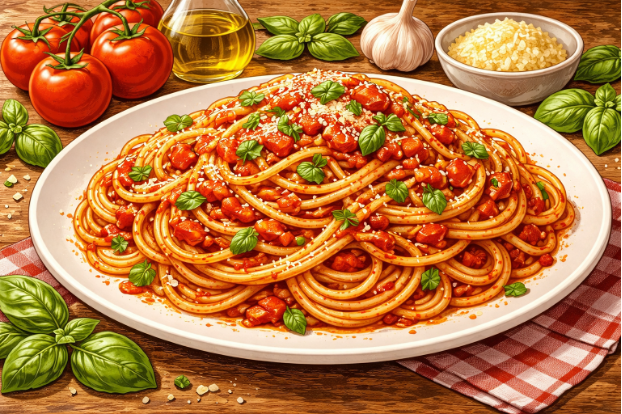
Few dishes in the world are as apparently simple — and as philosophically charged — as spaghetti al pomodoro. On the surface it is just pasta with tomato sauce. In practice it is one of the most revealing expressions of Italian cooking: a test of patience, judgement, and trust in ingredients.
The dish is most closely associated with Naples and Campania, where tomatoes found their true home in Italian cuisine. The volcanic soils around Mount Vesuvius produce tomatoes with a particular sweetness and acidity, especially San Marzano varieties, which became the backbone of Neapolitan cooking. Yet spaghetti al pomodoro is not about a specific tomato alone; it is about a way of treating tomatoes — gently, attentively, and without haste.
What makes this dish great is not complexity but proportion. A good pomodoro sauce should taste unmistakably of tomatoes, but not aggressively so. It should be bright without being sharp, rich without being heavy, and smooth without losing character. Achieving this balance requires understanding heat: too fast and the tomatoes taste raw and thin; too slow and they become dull and jammy.
The foundation is usually a very light soffritto — garlic (sometimes onion), softened slowly in olive oil until fragrant but never browned. This is not a base meant to dominate; it is simply a gentle perfume that lifts the tomatoes. In many classic versions, even onion is omitted, reinforcing how restrained this dish can be.
Time does the rest. Tomatoes are simmered just long enough to shed their rawness and merge with the oil into a silky sauce. The aim is not reduction to thickness, but transformation into harmony. A few torn basil leaves often enter near the end, their aroma preserved rather than cooked out.
Pasta technique is just as important as the sauce. In Italy, spaghetti is not merely topped with pomodoro; it is finished in it. The pasta is cooked to just under al dente, then tossed in the sauce with a splash of pasta water so starch binds everything together. This is why the dish feels cohesive rather than layered — pasta and sauce become one.
At the table, spaghetti al pomodoro is both humble and profound. It can be everyday food or restaurant fare, depending on the quality of ingredients and care in cooking. Many Italian chefs regard it as a benchmark: if you can cook a great pomodoro, you understand the soul of Italian cuisine.
For Cookdom, this dish is a perfect teaching moment. It brings together ideas of seasoning, heat control, timing, emulsification, and respect for produce — without hiding behind elaborate technique.
Spaghetti al pomodoro is therefore not just comfort food. It is a quiet manifesto: good cooking begins with listening to ingredients, not overpowering them.
Recipe (serves 2)
Ingredients
- 200 g dried spaghetti
- 500 g ripe fresh tomatoes or 400 g good-quality tinned whole tomatoes
- 2 tbsp extra-virgin olive oil
- 1 small garlic clove, lightly crushed
- A handful of fresh basil leaves
- Fine salt
- Freshly ground black pepper
Method
- If using fresh tomatoes, score the skins, blanch for 30 seconds, peel, deseed, and chop roughly. If using tinned, crush them gently by hand.
- Warm the olive oil in a wide pan over low heat. Add the garlic and cook gently for 1–2 minutes until fragrant but not coloured. Remove the garlic if you prefer a cleaner flavour.
- Add the tomatoes with a pinch of salt. Simmer gently for 12–15 minutes, stirring occasionally, until the sauce is silky and no longer raw-tasting. Tear in most of the basil near the end.
- Meanwhile, bring a large pot of salted water to the boil and cook the spaghetti until just under al dente.
- Transfer the pasta directly into the tomato sauce (do not drain completely). Add a small ladle of pasta water and toss for 30–45 seconds so the sauce coats every strand.
- If the sauce feels tight, add a little more pasta water; if loose, let it bubble briefly to thicken.
- Finish with a drizzle of fresh olive oil, the remaining torn basil, and black pepper.
- Serve immediately — glossy, bright, and alive with tomato flavour.